

By: GOLD MINERS CLUB
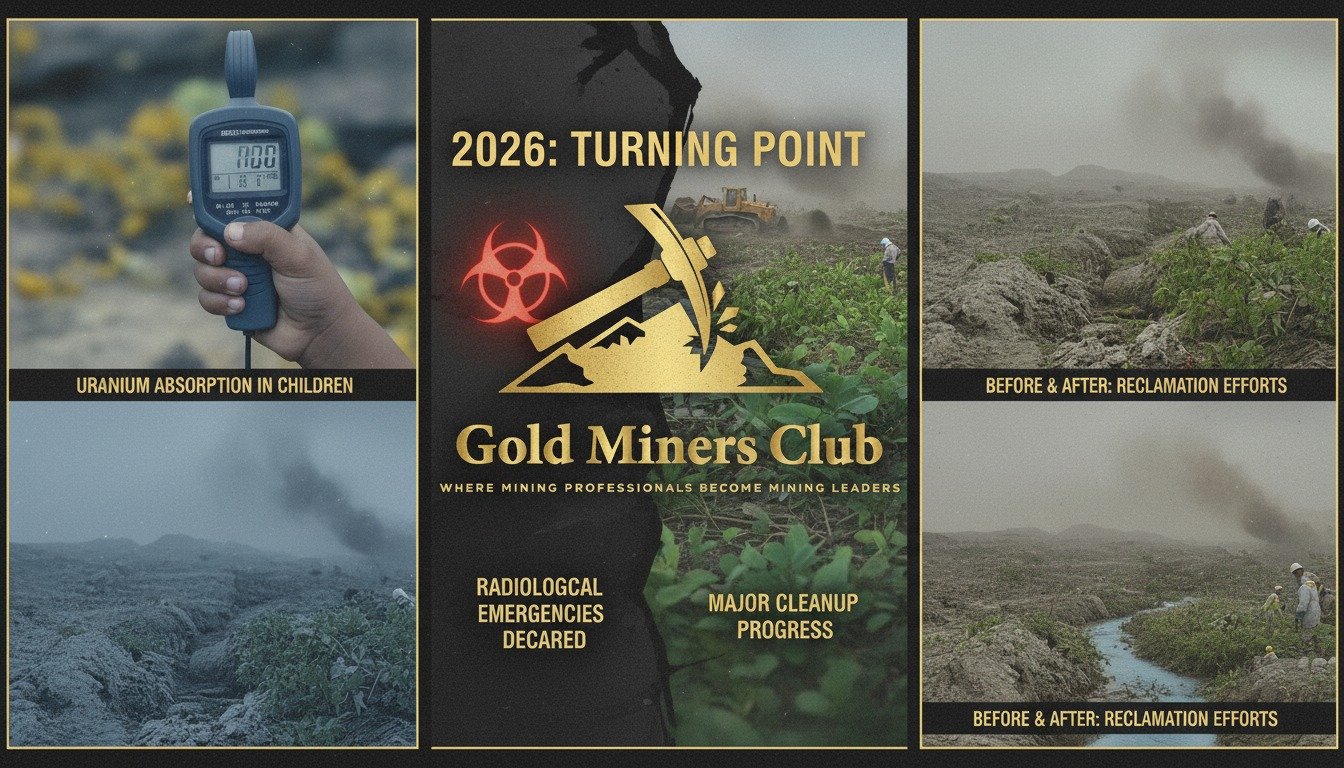
The year 2026 marks a turning point in global recognition of the hazards posed by radioactive mine tailings. Recent months have revealed uranium absorption in children, declarations of radiological emergencies, and major cleanup progress—showing both alarming discoveries and significant advances.
South Africa: Children Absorbing Uranium from Gold Tailings
The most alarming 2026 development: Researchers confirmed that children living near Johannesburg’s gold mine tailings absorb uranium.
A comprehensive study published in January 2026 in Environmental Geochemistry and Health analysed more than 400 hair samples from children in communities adjacent to mining dumps. The results showed a clear pattern: children in gold-mining areas had higher average hair uranium levels than those from uncontaminated reference sites.
Dr Susanne Sachs of the Helmholtz-Zentrum Dresden-Rossendorf (HZDR), who participated in the research, explained the significance: “The dumps are often located directly in densely populated residential areas. It is known that toxic substances are carried in dust particles by wind, soil, and water right up to the houses, particularly in the dry season.”
The study ruled out external contamination, confirming that uranium entered children’s bodies. Living near gold mine tailings increases risk by breathing dust and ingesting contaminated water or food.
While the measured levels do not yet allow immediate conclusions about specific health impacts—a follow-up epidemiological study would be required—the researchers emphasised the importance of the observation itself. “The study helps to reinforce communities’ awareness without stoking fears unnecessarily,” Sachs noted.
Mooifontein Tailings: Exceeding Global Safety Standards:
A separate study published in March 2026 in Discover Applied Sciences examined the Mooifontein gold tailings west of Johannesburg, near the Soweto community of Riverlea, where residents have long complained about “irritating yellow dust” being blown into their homes during windy seasons.
According to a recent study published in Nature, researchers measured the average concentration of Radium-226 at 302.99 Bq/kg at Mooifontein, which is significantly higher than the global average of 35 Bq/kg. The study did not report Uranium-238 levels for this site.
The research specifically warned that tailings soil should never be used as building material, as this would expose residents to dangerous internal radiation from radon gas and inhaled dust.
Roodepoort: Extreme “Hot Spots” Detected:
Adding to the mounting evidence from South Africa, a study published in Frontiers in Physics in January 2026 mapped the Roodepoort gold tailings with unprecedented detail. According to a study published on ScienceDirect, heavy metals such as arsenic and cadmium were found at extremely high contamination levels at 62 percent of the sites examined near gold and uranium mines in Johannesburg, South Africa. leading to radiation-induced carcinogenesis. According to the World Health Organization, in 2026, an estimated 7.5 million people in the Democratic Republic of Congo are expected to require urgent health assistance, especially in regions impacted by conflict, which increases concern about the risks posed by hazardous mine tailings and their potential impact on human settlements.
March 2026 saw an unprecedented official response in the Democratic Republic of Congo. On March 23, 2026, the DRC government declared a radiological emergency in the Remba T17 area of Kolwezi, Lualaba province, following the discovery of radioactive minerals being mined using artisanal methods.
Minister Marie-Thérèse Sombo said unregulated mining caused “proven radioactive contamination, threatening health, security, and the environment.”
Artisanal miners and local residents reported persistent coughing and bleeding, raising alarm. The New Congolese Civil Society demanded immediate action. Coordinator Lambert Mende urged the government to secure the site, evacuate miners, and quarantine exposed people.
The government has sent experts and teams to decontaminate and monitor radiation.
United States: Progress and Persistent Problems:
In 2026, the US Department of Energy’s Moab Project removed 16 million tons of uranium mill tailings from the Colorado River bank.
According to the Department of Energy, since 2009, uranium mill tailings have been transported by rail from the Moab site to Crescent Junction for disposal, where an engineered disposal cell is under construction.
Federal Cleanup Director Matt Udovitsch called the achievement “a testament to DOE’s commitment to safe cleanup and public health. According to a review published in 2026, efforts to clean up contaminated mine sites continue, including ongoing removal of polluted soil, as part of broader strategies to control contaminants and restore ecosystem function.
Cleanup elsewhere in the US faces setbacks. In St. Louis County, Missouri, investigators found radium in groundwater near the West Lake Landfill, where Manhattan Project-era nuclear waste was dumped. There have been concerns about increased rates of lung and bone cancers among local residents and fears of a potential “cancer cluster.” In France, uranium contamination in wetland areas remains an issue, as recent research confirms ongoing uranium accumulation in certain contaminated wetlands in the Mediterranean Alps, according to a study published in Environmental Science & Technology. Nigeria’s Jos Plateau, an area with a long history of tin mining, underwent evaluation for radiological impacts in 2026, according to a recent study. Research published in the Journal of Radioanalytical and Nuclear Chemistry analysed soil, tin tailings, and agricultural products, finding that uranium-238 in the tailings ranged from 111 to 3000 Bq/kg, while thorium-232 reached 6400 Bq/kg. Crucially, agricultural products grown in the region showed elevated activity concentrations exceeding reference values, indicating that contamination has entered the food chain.
The Global Pattern: A Public Health Crisis in Slow Motion:
2026 research shows a global trend: Mine tailings from gold, uranium, tin, and other minerals pose a threat to human health long after mining ends.
The mechanisms of harm are now well-documented:
- Inhalation of radioactive dust and radon gas
- Ingestion through contaminated water and food crops
- Direct external exposure to gamma radiation. International safety standards exist, but in 2026, evidence shows they are routinely violated in communities near mine tailings. These communities are impoverished, marginalised, and lack the political power to demand remediation.diation.
Looking Forward:
In 2026, the evidence is clear: radioactive tailings cause uranium uptake in children. Governments acknowledged this crisis, as shown by the DRC emergency.
The Moab cleanup shows that large-scale remediation is possible when leaders commit resources. The question is whether such efforts will reach hundreds of other sites—like those in South Africa, Nigeria, and the DRC—where radioactive waste still threatens communities.
According to a recent study assessing indoor radon exposure and health risks in a South African community near gold mine tailings, researchers aim to raise community awareness and encourage health action rather than cause panic. However, it remains uncertain whether 2026 will bring meaningful progress on this issue or simply more documentation.
News References:
- Sachs, S., et al. (January 2026). “Uranium absorption in children living near gold mine tailings in the Witwatersrand Basin.” Environmental Geochemistry and Health. Reported by Helmholtz-Zentrum Dresden-Rossendorf (HZDR) press release, January 15, 2026.
- Moodley, K., & Govender, I. (March 2026). “Radiological hazard assessment of Mooifontein gold tailings near Soweto.” Discover Applied Sciences, Vol. 8, Article 245. March 10, 2026.
- Oyedele, A., & van der Merwe, P. (January 2026). “High-resolution gamma spectroscopy of Roodepoort gold tailings: Identification of radioactive hot spots.” Frontiers in Physics, Vol. 14. January 28, 2026.
- Democratic Republic of Congo Ministry of Nuclear Affairs. (March 23, 2026). “Official declaration of radiological emergency – Remba T17 area, Kolwezi.” Government Press Release, Kinshasa. Reported by Radio Okapi and Reuters Africa, March 24, 2026.
- Mende, L. (March 2026). “New Congolese Civil Society demand for site evacuation and quarantine.” Statement to Agence France-Presse (AFP), Lubumbashi, March 25, 2026.
- US Department of Energy. (March 28, 2026). “Moab Uranium Mill Tailings Remedial Action Project reaches 16 million tons removed milestone.” DOE Press Release No. 2026-089, Washington, D.C.
- Nuclear Regulatory Commission. (Updated March 2026). “Backgrounder on Uranium Mill Tailings.” NRC Fact Sheet, March 2026.
- Missouri Department of Natural Resources. (February 2026). “Groundwater radium contamination detection update – West Lake Landfill.” MDNR Quarterly Environmental Report, Jefferson City, February 15, 2026.
- Schaller, J., & Foerstendorf, H. (March 2026). “Legacy uranium contamination in French wetlands: The Roffin storage site (1947-1956).” HZDR Research Report 2026-12, Dresden, March 5, 2026.
- Jwanbot, D.I., et al. (January 2026). “Radiological assessment of tin tailings and agricultural products on the Jos Plateau, Nigeria.” Journal of Radioanalytical and Nuclear Chemistry, Vol. 335, pp. 45-58. January 12, 2026.