
By: Gold Miners Club Published 17 November 2026
Gold has one global price on the screen, but the price you actually pay for a physical bar is rarely identical to it. The difference is the gold premium (or, when prices run below the benchmark, a discount). Understanding it explains why gold can cost more in Shanghai than in London, why Indian dealers have recently been selling below domestic prices, and why the question “which is the biggest gold exchange?” has more than one answer.
Gold Premium Explained: Why Physical Gold Rarely Trades at Spot
A gold premium is the amount by which the price of physical gold in a particular market or form is above the international benchmark, usually the London LBMA price or global spot gold. It is normally quoted in US dollars per troy ounce. A negative number is a discount.
The term is used in two related ways:
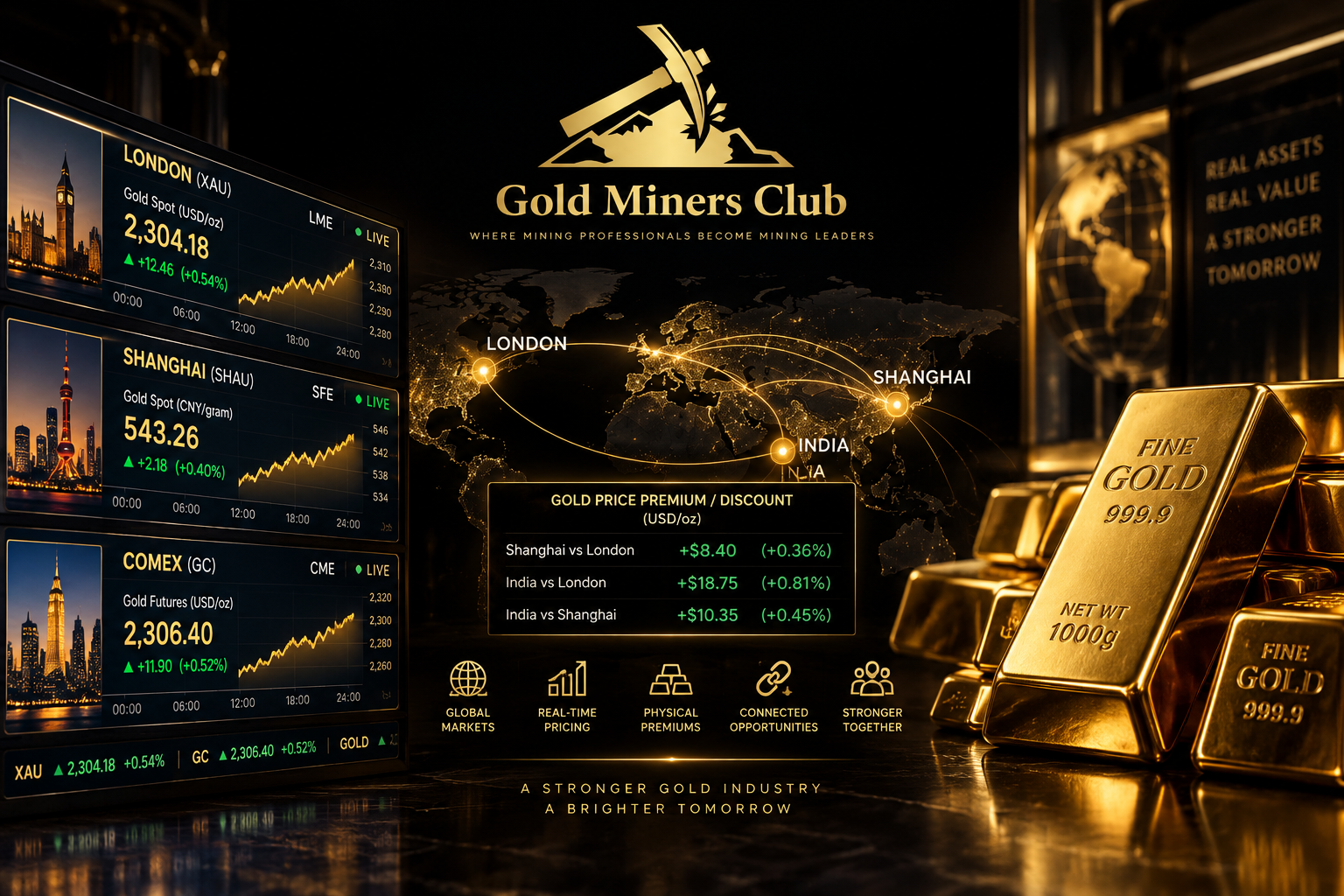
- Exchange or market premium: the gap between an onshore price, such as the Shanghai Gold Exchange (SGE) Au99.99 benchmark, and the London price.
- Dealer premium: the extra charge a bullion dealer adds over spot for bars or coins to cover fabrication, insurance, transport and profit. Weekly Asian market reports quote these figures for China, Hong Kong, Singapore, Japan and India.
Five Forces That Create Gold Premiums and Discounts
In a perfectly open market, arbitrage would erase any gap: if gold were dearer in Shanghai, traders would ship in metal from London and pocket the difference. Premiums exist because that process is limited by real-world frictions.
- Import controls and quotas. China regulates gold imports, and the amount of metal that can enter the market affects how easily a premium can be closed. When supply is tight, local prices rise above London.
- Taxes and duties. India’s dealer discounts and premiums are quoted against official domestic prices that already include import and sales levies. A sharp duty increase in 2026 helped push Indian discounts to record levels.
- Currency moves. A weaker local currency makes gold dearer in local terms and can lift demand for it as a store of value, widening the premium.
- Physical demand. Festival seasons, weddings, Lunar New Year, central-bank buying and investor safe-haven demand all push premiums up. Very high prices can have the opposite effect, cutting jewellery demand and pushing premiums towards zero or into discount.
- Logistics and liquidity. Vault space, refining capacity, shipping and insurance all feed into what buyers pay for physical metal.
Because of all this, analysts treat the Shanghai premium as a clean read on Chinese physical demand. Chinese authorities exempted standard gold traded on the SGE and the Shanghai Futures Exchange from VAT from 1 November 2025, so recent premiums are less distorted by tax than they used to be.
Gold Premiums in 2026: China Swings, India Discounts, Hong Kong Steady
- China: Premiums have swung widely this year. Reuters reported premiums of around $35 an ounce in early February, ahead of Lunar New Year, and $15 to $20 in mid-May. By July, bullion in China traded between a $1 discount and a $5 premium, and one data tracker showed the SGE Au99.99 benchmark almost exactly level with US spot in mid-August.
- India: Dealers offered record discounts in May after an import duty increase, with discounts of up to $207 an ounce reported in one week before easing.
- Hong Kong, Singapore and Japan: Premiums stayed small, typically within a few dollars of the benchmark, reflecting open, liquid markets with fewer restrictions.
- Hong Kong’s gold hub push: In July, Hong Kong launched a central clearing system for gold and revived dollar gold futures as it seeks to become a regional gold reserve hub.
- Historical extreme: China’s premium hit a record above $120 an ounce in 2022, when Beijing was defending the yuan, which shows how violent the swings can be.
Biggest Gold Exchange in the World: COMEX, London or Shanghai?
The honest answer depends on how you measure “biggest.” Three venues dominate global gold trading.
| Venue | Type | Why it matters |
|---|---|---|
| COMEX (CME Group), New York | Futures and options | Usually the largest by traded volume and the main venue for price discovery. Estimates put daily volume at roughly 27 million ounces, with a growing share traded during Asian hours. |
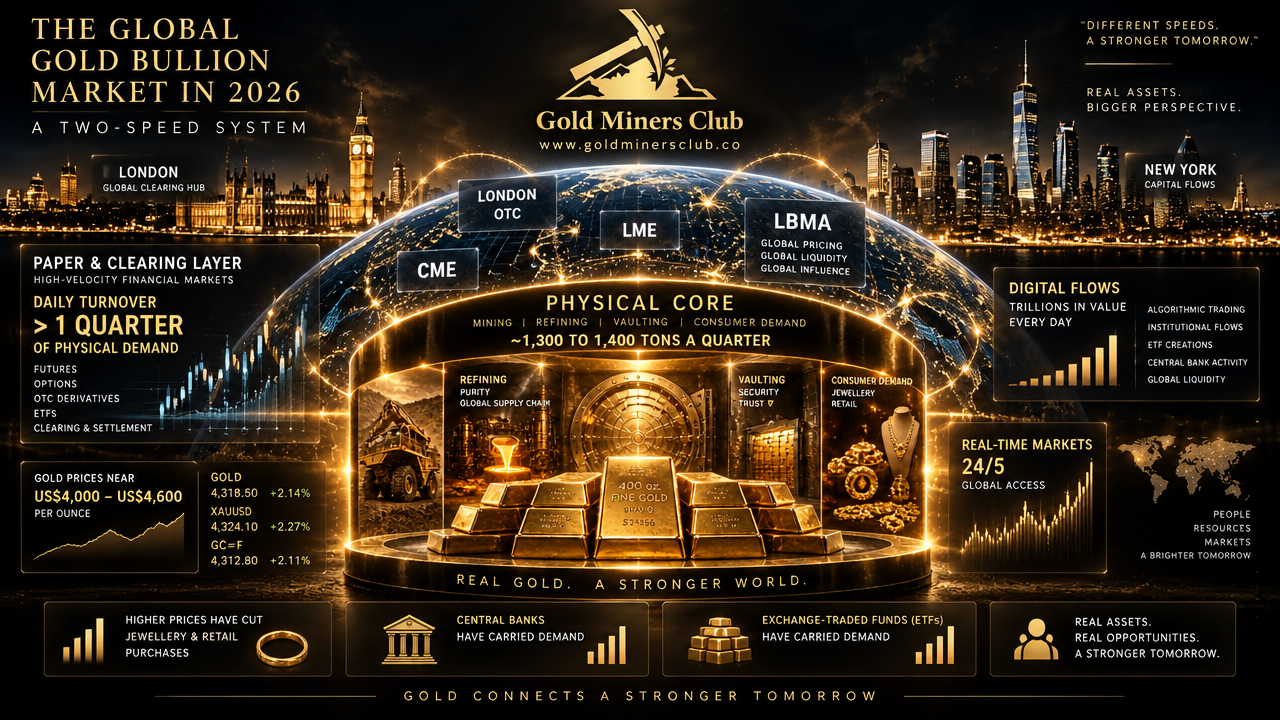
| London OTC market (LBMA) | Over-the-counter wholesale | The world’s largest wholesale gold market by volume, home to the twice-daily LBMA Gold Price used as the physical benchmark. |
| Shanghai Gold Exchange (SGE) | Physical spot exchange | The world’s largest physical gold exchange. Founded in 2002, it serves China, the biggest consumer and producer of gold, and most gold traded there is actually delivered. |
Short answer: COMEX is the biggest gold futures exchange, London is the biggest wholesale market, and the Shanghai Gold Exchange is the biggest physical gold exchange. An older industry survey showed COMEX volumes far ahead of Chinese venues in 2016, because most COMEX trading is paper contracts rather than metal changing hands. The World Gold Council names London OTC, the US futures market and the SGE as the three most important trading centres.
Why the Shanghai Gold Premium Matters to Investors and Miners
- Demand signal: A rising premium suggests strong physical buying and tight onshore supply; a discount suggests weak demand or ample stock.
- Price discovery: As Shanghai’s volumes and influence grow, Chinese trading hours increasingly shape global gold prices.
- Costs and margins: For refiners, miners and bullion traders, premiums affect where metal is sold, how it is financed and how it is shipped.
- Policy watch: Import quotas, tax changes, and currency policy can shift premiums quickly, so they are worth monitoring alongside spot price.
Gold Premium FAQs: Quick Answers
What does it mean when gold trades at a premium? It means the physical price in a given market or product is above the global benchmark. A discount means the opposite.
Why is gold more expensive in China than in London? Import limits, strong investment and jewellery demand and currency moves can leave Chinese onshore prices above London. The gap is not constant and has recently narrowed to near zero at times.
Which is the largest gold exchange in the world? COMEX is the largest by futures trading volume, the London market is the largest wholesale market, and the Shanghai Gold Exchange is the largest physical gold exchange.
Is a high gold premium good or bad? It depends on your side. Buyers pay more; sellers and importers may earn more. For investors it is mainly a gauge of physical tightness.
This article is for information only and is not financial advice. Check live figures before trading.
News and Data Sources
- Reuters via Mining Weekly, “India discounts soar to record high on import duty hike; China premiums firm,” 15 May 2026. https://www.miningweekly.com/article/india-discounts-soar-to-record-high-on-import-duty-hike-china-premiums-firm-2026-05-15
- Reuters via Kitco, “Asia Gold: Price volatility keeps India demand subdued, China premiums ease,” 22 May 2026. https://www.kitco.com/news/off-the-wire/2026-05-22/asia-gold-price-volatility-keeps-india-demand-subdued-china-premiums
- Reuters via Kitco, “Asia Gold: Gold discounts in India deepen as volatility hurts demand; purchases in China steady,” 10 July 2026. https://www.kitco.com/news/off-the-wire/2026-07-10/asia-gold-gold-discounts-india-deepen-volatility-hurts-demand
- Reuters via Khaleej Times, “India gold premiums down by half; China demand up ahead of Lunar New Year,” 6 February 2026. https://www.khaleejtimes.com/world/asia/india-gold-premiums-down-by-half-china-demand-up
- Reuters via Engineering News, “India gold demand stays muted as buyers await lower prices; China premiums steady,” 18 September 2026. https://www.engineeringnews.co.za/article/india-gold-demand-stays-muted-as-buyers-await-lower-prices-china-premiums-steady-2026-09-18
- World Gold Council, “Global gold market” (London OTC, US futures and Shanghai Gold Exchange). https://www.gold.org/what-we-do/gold-market-structure/global-gold-market
- World Gold Council, “Weekly Markets Monitor: Golden Week in China,” September 2026. https://www.gold.org/goldhub/gold-focus/2026/09/weekly-markets-monitor-golden-week-china
- MetalCharts, “China gold price vs US spot (SGE Au99.99),” data as of 17 August 2026. https://metalcharts.org/china/xau
- The Vault Report, “Shanghai Gold Premium Today,” July 2026 (VAT exemption, MOF/STA Announcement No. 11/2025). https://thevaultreport.com/tools/shanghai-premium
- BullionStar, “London Gold Market” and “SGE trading volumes” analysis. https://www.bullionstar.com/gold-university/chinese-cross-bord
- Xetra-Gold, “The world’s largest gold exchanges” (2016 volume survey). https://www.xetra-gold.com/en/detail/the-worlds-largest-gold-exchanges
- Mining.com, “China gold premium hits record as Beijing defends yuan.” https://www.mining.com/web/china-gold-premium-hits-record-as-beijing-defends-yuan
- Mining Weekly, “Shanghai Gold Exchange” topic page. https://www.miningweekly.com/topic/shanghai-gold-exchange