By: GOLD MINERS CLUB Date: 23 November 2026
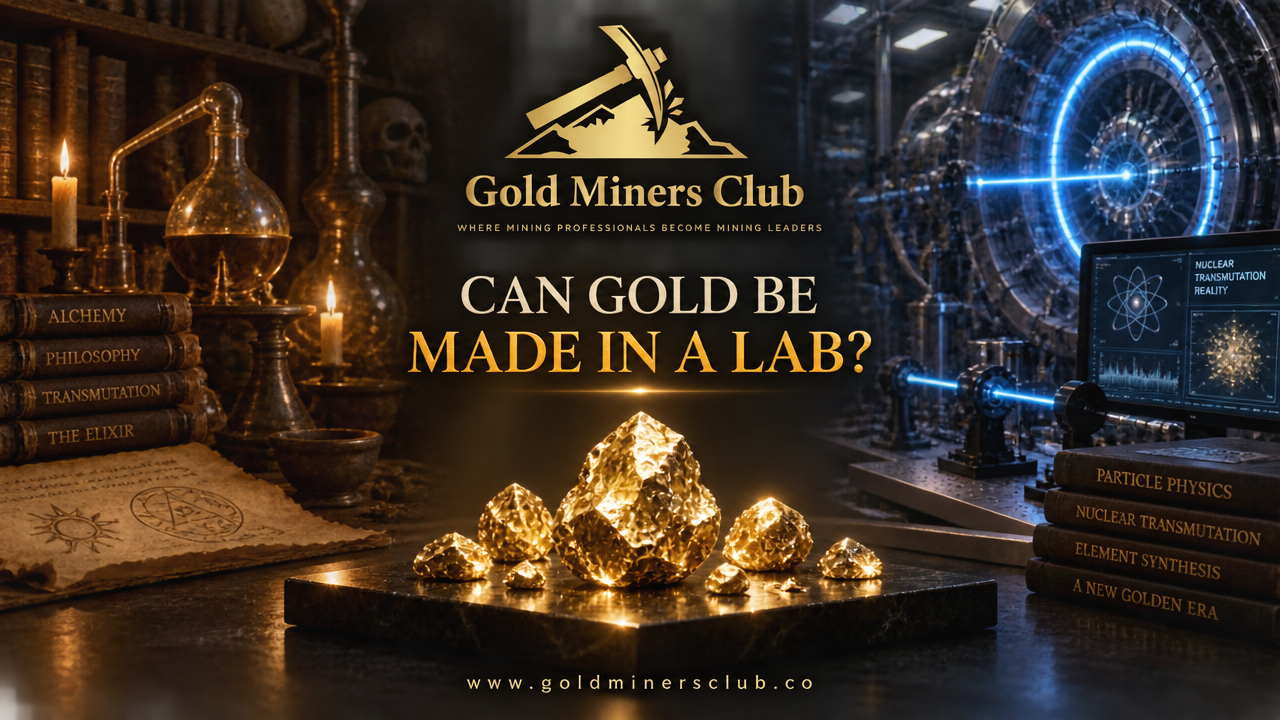
For thousands of years, people tried to turn cheaper metals into gold. In 2026, with gold prices at record highs, the question is back in the news: can gold be made in a lab? The answer is yes, in tiny amounts and at enormous cost. Whether that can ever become economical is still unproven.
Why gold can’t be made chemically
Gold has 79 protons. Mercury has 80, and lead has 82. Chemical reactions only rearrange atoms, so gold has to be made by changing another element’s nucleus through nuclear transmutation. That is why every pre-20th-century attempt failed. Chemistry cannot do it. businesstoday
The early claims (1920s–1940s)
In 1924, Adolf Miethe and Hans Stammreich in Berlin announced they had made gold from mercury. Hantaro Nagaoka in Tokyo reported something similar, using a very high-voltage discharge through mercury. The claims did not hold up. Fritz Haber first said he had confirmed the results, then retracted that when further analysis showed only tiny amounts of gold. A Scientific American-funded replication effort that began in December 1924 ended in complete failure to confirm the transmutation. The now-forgotten transmutation controversy hung on apparent evidence of mercury transforming into gold +3
The first credible results came with nuclear physics. In 1941, researchers bombarded mercury with fast neutrons and transmuted it into gold and platinum. That experiment was reported by Sherr, Bainbridge and Anderson in Physical Review. scienceabc
Seaborg’s bismuth experiment (1980)
At Lawrence Berkeley National Laboratory’s Bevalac accelerator, researchers fired carbon and neon beams at bismuth foils. Some collisions knocked four protons out of a bismuth nucleus and left gold. Glenn Seaborg was the senior author, and one estimate put the cost of producing gold this way at over a quadrillion dollars per ounce. It was proof of principle, and nothing close to a business. Scientific AmericanScientific American
CERN’s fleeting gold (2025)
The ALICE collaboration reported that about 86 billion gold nuclei were created at the four major LHC experiments during Run 2 (2015–2018). They came from “near-miss” collisions. Lead nuclei that pass close together interact through their electromagnetic fields, which can strip off protons. Losing three protons turns lead (82) into gold (79). The LHC currently produces gold at a maximum of about 89,000 nuclei per second at the ALICE collision point. The gold doesn’t last, though. The nuclei slam into the beam pipe and shatter almost instantly. ALICE detects the transformation of lead into gold at the LHC +3
The fusion route: Marathon Fusion (2025–2026)
The newest chapter is commercial rather than purely scientific. In 2025, the startup Marathon Fusion posted a preprint proposing that the neutron-multiplying reactions already needed in deuterium-tritium fusion blankets could turn mercury into gold at scale. iflscience
The idea uses mercury-198, about 10% of natural mercury. A fast fusion neutron knocks a neutron loose, leaving unstable mercury-197. That isotope has a half-life of roughly 64 hours and decays into gold-197, the only stable form of gold. The preprint’s simulation estimated about 2 tonnes of gold per gigawatt of thermal power per year, and it has not been peer-reviewed. Could Fusion Plants Pay for Themselves With Gold? A US Startup Claims It Turned Mercury Into Gold, but Key Data Are Missing +2
On October 21, 2026, the company announced it had transmuted mercury into stable gold with fusion neutrons, claiming a rate ten times CERN’s 2025 benchmark. It posted gamma-ray spectra showing signatures associated with mercury-197 and gold-197. The caveats are significant: gadgetreview
- The company has not disclosed how much gold it produced or what the process costs. business-standard
- No independent verification was publicly available at the time of reporting. gadgetreview
- Commercial use would need enriched mercury and fusion plants that don’t exist yet, and the gold might have to sit in storage for 14 to 18 years while its radioactivity fades. interestingengineering
- Max Planck fusion researcher Karl Lackner estimated that even using all the mercury in the Earth’s crust would give only about 600 tonnes of gold a year, a fifth of current global production. mpg
Other claims
In November 2026, a Bengaluru inventor’s patented system was reported to have found gold in processed lab samples (1.91 and 2.3 mg per litre by ICP-AES). Reporters noted that detecting gold does not prove mercury was converted into it, and that independent testing and repeated experiments would be needed. The pattern echoes the 1920s: a trace of gold is not proof of transmutation. businesstodaybusinesstoday
Could lab gold crash gold prices?
Commentators compare it to lab-grown diamonds, but analysts argue the economics are completely different, and that producing gold at a scale and cost that could influence global markets remains unproven. A 2026 Harvard Belfer Center analysis also warned against assuming recent fusion advances mean commercial deployment is imminent. As one report put it, lab-made gold is technically real and can be refined to 24K, but today it is more a scientific experiment than a commercial reality. Lab-Made Gold Unlikely To Disrupt Global Supply Or Prices Anytime Soon +2
Where things stand (November 2026)
| Year | Who | Method | Result |
|---|---|---|---|
| 1924 | Miethe, Nagaoka | Electric discharge | Not reproducible |
| 1941 | Sherr et al. (Harvard) | Fast neutrons on mercury | Gold detected |
| 1980 | Seaborg et al. (Berkeley) | Heavy-ion beams on bismuth | Thousands of atoms |
| 2025 | ALICE (CERN) | Lead–lead near-misses | Billions of nuclei, fleeting |
| 2025–26 | Marathon Fusion | Fusion neutrons on mercury-198 | Claimed, unverified |
Lab gold is real physics. The open question is economics, since no method yet makes gold for less than mining it costs. Fusion-based transmutation is the first proposal where gold would be a byproduct of a machine built for another purpose, but it depends on reactors that haven’t been built and on data that hasn’t been published.
News & Source References
- BusinessToday, “Mercury to gold: Marathon Fusion claims 10x CERN record” (Oct 22, 2026): https://www.businesstoday.in/technology/story/mercury-to-gold-marathon-fusion-claims-10x-cern-record-but-can-modern-alchemy-work-563022-2026-10-22
- Gadget Review, “Marathon Fusion Claims Mercury-to-Gold Transmutation Without Disclosing Key Data”: https://www.gadgetreview.com/?p=422725
- Nature World News, “Could Fusion Plants Pay for Themselves With Gold?” (Oct 26, 2026): https://www.natureworldnews.com/articles/73654/20261026/could-fusion-plants-pay-themselves-gold-us-startup-claims-it-turned-mercury-gold-key-data.htm
- Business Standard, “US startup claims it turned mercury into gold in lab using nuclear fusion”: https://www.business-standard.com/world-news/us-startup-claims-it-turned-mercury-into-gold-in-lab-using-nuclear-fusion-126102300985_1.html
- BusinessToday, Bengaluru inventor’s patented technology (Nov 18, 2026): https://www.businesstoday.in/science/story/mercury-turned-into-gold-bengaluru-inventors-patented-technology-reports-gold-and-silver-in-lab-samples-568191-2026-11-18
- MENAFN / eToro, “Lab-Made Gold Unlikely To Disrupt Global Supply Or Prices”: https://menafn.com/1111880283/Lab-Made-Gold-Unlikely-To-Disrupt-Global-Supply-Or-Prices-Anytime-Soon
- BusinessToday, “Is lab-grown gold the future or just a costly experiment?” (Apr 6, 2026): https://www.businesstoday.in/personal-finance/investment/story/is-lab-grown-gold-the-future-or-just-a-costly-experiment-524063-2026-04-06
- CERN/ALICE, “ALICE detects the transformation of lead into gold at the LHC” (May 2025): https://home.cern/alice-detects-conversion-lead-gold-lhc/
- S. Acharya et al. (ALICE), Phys. Rev. C 111, 054906, doi:10.1103/PhysRevC.111.054906
- CERN Courier, “Alchemy by pure light” (Nov 2025): https://cerncourier.com/a/alchemy-by-pure-light/
- Scientific American, “Fact or Fiction: Lead Can Be Turned into Gold”: https://www.scientificamerican.com/article/fact-or-fiction-lead-can-be-turned-into-gold/
- Chemistry World, on the 1920s transmutation controversy: https://chemistryworld.com/opinion/the-1920s-chemists-who-thought-theyd-achieved-the-alchemists-dream/4019452.article
- Nature 114, 197–198 (1924), “The Reported Transmutation of Mercury into Gold”: https://www.nature.com/articles/114197a0
- IFLScience, Marathon Fusion preprint coverage (July 2025): https://www.iflscience.com/marathon-fusion-claims-they-have-a-method-for-transmuting-mercury-into-gold-80132
- Max Planck Society, “Five Questions” with Karl Lackner: https://www.mpg.de/25735182/S006_Five_Questions_074.pdf
- Parisi & Schiller (Marathon Fusion), “The Value and Cost of Fusion Neutrons,” arXiv:2603.00835