

By: GOLD MINERS CLUB
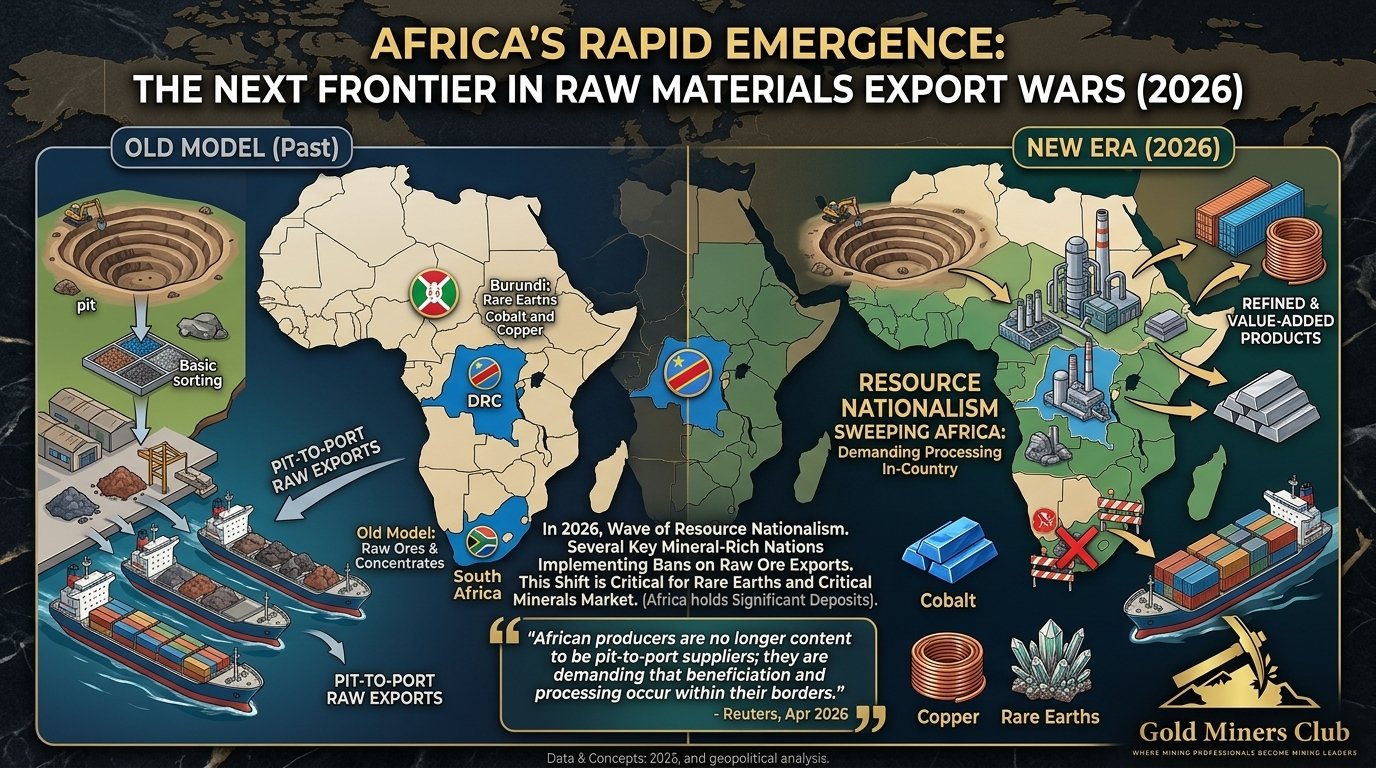
While much of the geopolitical focus has been on Asia, Africa is rapidly emerging as the next frontier in the raw materials export war. In 2026, a wave of resource nationalism is sweeping across the continent, with several key mineral-rich nations implementing or threatening to implement bans on the export of unprocessed or partially processed ores and concentrates.
This shift is particularly critical for the rare earths and critical minerals market because Africa holds significant deposits of light rare earths (in places like Burundi and South Africa) and is a major supplier of cobalt and copper concentrates that often contain rare-earth by-products. As Reuters reported in April 2026, “African producers are no longer content to be pit-to-port suppliers; they are demanding that beneficiation and processing occur within their borders.”
Key African Export Restrictions in 2026
- Burundi (Rare Earths Concentrates): Burundi, home to the Gakara rare earth project (one of the world’s richest rare earth deposits), has been at the forefront of this movement. In January 2026, the Burundian government announced a significant hike in export taxes on unprocessed rare earth concentrates, effectively reducing the flow of ore to Chinese refineries. According to Mining Weekly (February 2026), the government has mandated that all miners must present a clear plan for local processing within 18 months, or face a complete export halt. This has caused significant supply jitters for European buyers who rely on the Gakara feedstock.
- Democratic Republic of Congo (DRC) (Cobalt & Concentrates): While primarily known for cobalt, the DRC produces significant copper-cobalt concentrates that often contain trace rare earths. In March 2026, the DRC’s Ministry of Mines issued a new decree restricting the export of unrefined concentrates from artisanal and small-scale mining sites. Bloomberg reported (March 2026) that the government cited “loss of revenue and environmental degradation” as justification, but industry analysts view it as a direct attempt to force processing companies—many of which are Chinese-owned—to build refining capacity inside the country rather than shipping bulk concentrates to Zambia or China.
- Zimbabwe (Lithium & Rare Earths): Though Zimbabwe is a significant lithium player, its pegmatite ores also contain rare earth elements. In mid-2026, Zimbabwe doubled down on its 2023 raw ore export ban. According to The Africa Report (May 2026), Zimbabwe’s Mines Minister stated that “no raw ore or concentrate will leave the country.” This has forced several junior mining companies to partner with Chinese and European firms to build “modular processing plants” on-site, dramatically increasing the capital expenditure required to bring new rare earth projects online.
- Angola (Heavy Mineral Sands): Angola is a rising player in the rare earth space due to its heavy mineral sand deposits containing monazite (a rare earth phosphate). In February 2026, the Angolan government issued a presidential decree requiring that all heavy mineral concentrates be processed locally before export, citing the “national imperative to industrialize.” Argus Media noted that this has disrupted supply agreements with European and American magnet makers who were relying on Angola as a new, non-Chinese source of feedstock.
The Ripple Effect: “Concentrate Blackouts”
The aggregate effect of these African export curbs is what industry insiders are now calling a “concentrate blackout.” Unlike China, which restricts the export of finished rare earth products, African nations are restricting the raw ingredients. This is more damaging in the short term because it creates a feedstock scarcity for the few Western processing plants that exist.
As reported by Fast markets (June 2026), the price of rare earth carbonates (an intermediate product derived from concentrates) has risen by 40% since January, largely driven by the uncertainty surrounding African supply chains. The East African (April 2026) highlighted that “African governments are watching the EU’s Critical Raw Materials Act closely, realizing that the West’s desperation for supply gives them unprecedented leverage.”
The Western Dilemma
For Western governments and corporations, the African export restrictions present a profound challenge. The US and EU have been courting African nations as “reliable partners” to counter Chinese dominance. However, these new export bans force Western companies to build expensive processing infrastructure in Africa—a task many are reluctant to undertake given the continent’s infrastructure challenges and political volatility.
S&P Global Commodity Insights (May 2026) pointed out that “The US Defense Department is quietly funding feasibility studies in Tanzania and Namibia to build ‘regional processing hubs,’ but these are years away from operational status.” In the meantime, the restriction of raw ores from Africa is depleting the operational capacity of existing processors, pushing the global rare earth market deeper into deficit as we head into the second half of 2026.
References:
- Reuters, “African producers pivot to local processing in minerals push,” April 2026.
- Mining Weekly, “Burundi tax hikes threaten rare earth concentrate supply,” February 2026.
- Bloomberg, “DRC tightens grip on copper-cobalt concentrate exports,” March 2026.
- The Africa Report, “Zimbabwe doubles down on raw ore export ban,” May 2026.
- Argus Media, “Angola restricts heavy mineral sands exports,” February 2026.
- Fastmarkets, “Rare earth carbonate premiums spike on African supply fears,” June 2026.
- The East African, “Resource nationalism reshapes critical mineral trade,” April 2026.
- S&P Global Commodity Insights, “US scrambles for African processing partners