

By: GOLD MINERS CLUB Date: 08-10-2026
Annual industry gathering becomes battleground for two financial rivals courting bullion business
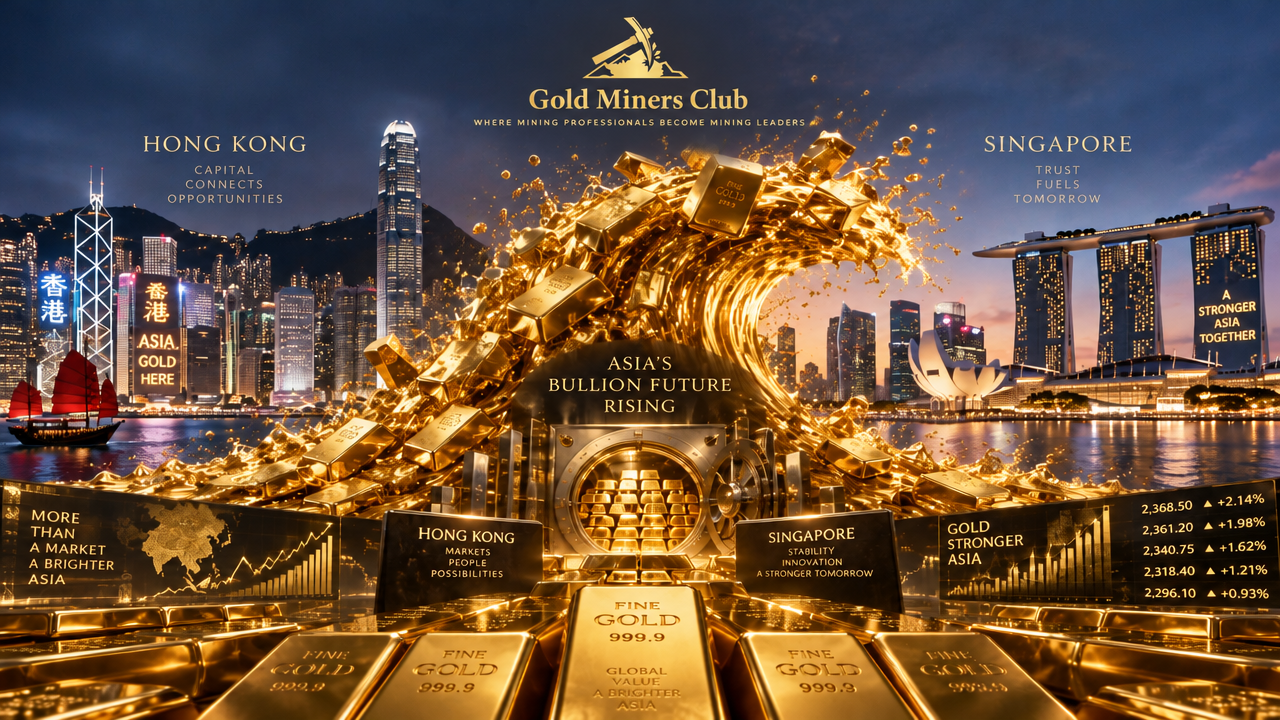
Hong Kong and Singapore have intensified their long-running rivalry for dominance in Asia’s bullion trade, with senior officials from both financial centers using a major annual industry gathering to unveil competing visions for establishing the region’s pre-eminent gold trading hub.
The dueling pitches, delivered during the same week of industry events, underscore the fierce competition between the two cities for a share of soaring Asian demand for gold — demand that has beAnnual industry gathering becomes battleground for two financial rivals courting bullion businessen fueled by central bank buying, geopolitical uncertainty, and record-breaking prices.
Hong Kong Positions Itself as Gateway to Mainland China
Hong Kong’s officials used the platform to promote the city’s unique advantage as the gateway to mainland China, the world’s largest gold consumer and producer. They outlined plans to expand the territory’s gold vaulting capacity, streamline cross-border bullion flows, and deepen linkages with the Shanghai Gold Exchange.
Speaking at the industry gathering, representatives from the Hong Kong government and the Airport Authority highlighted the city’s established infrastructure, including the Hong Kong International Airport’s precious metals depository, which offers secure storage and logistics for bullion traders. Officials also pointed to the city’s free port status, robust legal system, and deep liquidity pools as key differentiators.
Hong Kong has long served as a conduit for gold flowing into and out of mainland China, and officials signaled that further integration with the Greater Bay Area would be central to its strategy. The city is reportedly exploring expanded quota arrangements and new trading products to attract both institutional and retail investors across Asia.
Singapore Pitches Stability and Innovation
Singapore, for its part, used the gathering to pitch itself as a stable, innovation-friendly jurisdiction with growing influence in the global gold market. Officials from the Monetary Authority of Singapore and Enterprise Singapore emphasized the city-state’s role as a trusted vaulting location, its expanding network of free trade agreements, and its push into digital gold products and tokenised bullion.
Singapore has invested heavily in its precious metals ecosystem in recent years, including the development of secure vaulting facilities and the promotion of gold-backed financial products. Officials argued that the city’s neutrality, regulatory predictability, and strong intellectual property protections make it an attractive base for global bullion firms seeking an Asian foothold.
The city-state has also sought to position itself as a hub for sustainable and responsibly sourced gold, appealing to institutional investors with environmental, social, and governance mandates.
Competition Reflects Broader Strategic Stakes
The rivalry between Hong Kong and Singapore for gold hub status is part of a broader contest for financial services leadership in Asia. Both cities have courted banks, asset managers, and trading firms, offering incentives ranging from tax breaks to streamlined licensing regimes.
Analysts note that the two hubs are not merely competing for trading volumes but for the broader ecosystem of vaulting, refining, financing, and logistics that supports the gold industry. The winner could capture significant economic spillovers, including jobs, tax revenue, and ancillary financial services.
The stakes have been raised by the surge in gold demand across Asia. Central banks in the region have been among the most active buyers of bullion, seeking to diversify reserves away from the US dollar. Retail investors in China, India, and Southeast Asia have also turned to gold as a hedge against inflation and currency volatility.
Demand Tailwinds Fuel Ambitions
Global gold prices have repeatedly set record highs in recent years, with Asian buying often cited as a key driver. The World Gold Council has reported sustained strength in Asian jewelry demand, bar and coin investment, and central bank purchases.
Both Hong Kong and Singapore are seeking to capture a larger share of this flows. Hong Kong’s proximity to mainland China gives it a natural advantage in servicing the world’s biggest consumer market, while Singapore’s appeal lies in its role as a neutral, well-regulated international financial center with strong links to Southeast Asia and India.
Industry participants at the gathering said the competition was healthy and could ultimately deepen liquidity and improve infrastructure across the region. However, some cautioned that overlapping ambitions could lead to fragmentation if the two hubs pursue incompatible standards or duplicate costly infrastructure.
A Race With Regional Implications
The outcome of the Hong Kong-Singapore contest could have implications beyond the two cities. Other Asian financial centers, including Shanghai, Tokyo, and Dubai, have also expressed ambitions to grow their gold trading footprints.
For now, officials from both Hong Kong and Singapore appear determined to press their advantages. The annual gathering made clear that the race to become Asia’s premier gold hub is far from settled — and that both cities intend to compete aggressively for the business of a metal that continues to command global attention.
As one industry executive observed at the close of the event, “The gold doesn’t care where it’s stored. But the cities certainly do.”
References
- Reuters. (2026). Hong Kong, Singapore pitch rival gold hub plans at industry gathering. Reuters.
- Bloomberg. (2026). Asian Gold Demand Surges as Central Banks Boost Reserves. Bloomberg News.
- World Gold Council. (2026). Gold Demand Trends: Full Year 2025. World Gold Council.
- South China Morning Post. (2026). Hong Kong eyes expanded gold vaulting capacity to capture mainland demand. SCMP.
- The Straits Times. (2026). Singapore pushes tokenised gold and sustainable sourcing in bid for bullion hub status. The Straits Times.
- Financial Times. (2026). Hong Kong and Singapore compete for Asian gold trading supremacy. Financial Times.
- Nikkei Asia. (2026). Asia’s gold rush: How regional hubs are vying for bullion flows. Nikkei Asia.