
By: Gold Miners Club
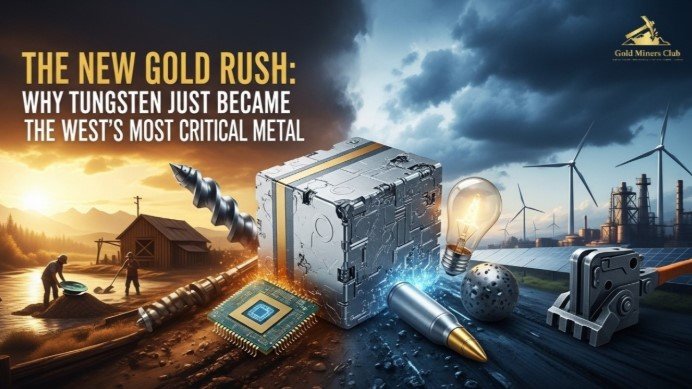
If there is one metal that can both transform into a sharp arrow capable of piercing armor and serve as the cornerstone for manufacturing cutting-edge chips, it must be tungsten. However, this “industrial tooth,” as it is often called, is currently experiencing an unprecedented price surge. As of March 2026, international tungsten prices have skyrocketed by an astonishing 557% over the past year, reaching a historical high of $2,250 per metric ton unit. This surge not only leaves traditional commodities like gold and copper far behind but also sounds a stark alarm in the global critical minerals sector.
A Perfect Supply and Demand Storm:
The irrational exuberance of tungsten prices is no accident but a “perfect storm” caused by the convergence of supply constraints and exploding demand.
On the supply side, policy adjustments in China served as the catalyst for this storm. As the undisputed global leader in tungsten supply, China accounts for approximately 79% of global production and 82.3% of global mine output. In February 2025, China’s Ministry of Commerce imposed export controls on certain tungsten-related items. While aligning with international practices, this move directly touched the most sensitive nerve of the global supply chain. Data indicates that the export volume of restricted tungsten products plummeted by about 40%. Overseas manufacturers, long reliant on cheap Chinese supplies, suddenly found their inventories running low, with no alternative sources in sight.
Simultaneously, the flames of demand are burning brighter than ever. Unlike previous cycles driven mainly by the construction and metal processing industries, the biggest driver of this tungsten rally comes from the battlefield. The prolonged attrition in the Russia-Ukraine conflict and the sudden escalation of tensions in the Middle East have starkly revealed the nature of modern warfare: it is a war of tungsten consumption. George Heppel, Vice President of Commodity Research at BMO Capital Markets, aptly pointed out: “In the modern warfare of the 21st century, woven from networks of thousands of drones and interceptor missiles, the importance of tungsten has never been more pronounced.”
The Dual-Use Engine: The “Grain” for Both Armor-Piercing Shells and Chips:
The reason tungsten has become a strategic focal point lies in its irreplaceable dual-use nature. In the military sector, tungsten alloys, with a density of up to 19.25 g/cm³, are the material of choice for manufacturing armor-piercing projectiles, missile components, and crucial counterweights for aircraft. When a projectile needs to penetrate thick armor, tungsten’s density allows it to maintain momentum; when a helicopter rotor needs balancing, tungsten counterweights are indispensable. Project Blue estimates that military-related tungsten consumption alone will grow by 12% this year.
In the civilian high-tech sector, tungsten is equally foundational. Semiconductor manufacturing equipment requires high-temperature resistant tungsten electrodes; smartphone vibration motors rely on tungsten weights; and turbine blades in aerospace engines depend on tungsten’s high-temperature resistance. This dual-use capability—”both piercing armor and making chips”—makes tungsten’s position in the modern industrial chain unassailable.
The market’s reaction has been severe. Because tungsten is not traded on major exchanges and its market size is only about $16 billion (roughly 5% of the copper market), the lack of liquidity means any supply-demand imbalance is drastically amplified by price leverage. Traders admit that not even the lithium frenzy of 2021 saw such tightness—lithium, at the time, still had a pipeline of pending projects, while tungsten does not.
Western Anxiety and the Dawn of New Mines:
Facing tightening supply from China, Western nations, led by the United States, are experiencing a period of strategic anxiety. Data from the U.S. Geological Survey shows that about 60% of U.S. tungsten is used for cemented carbide components, which are critical for the construction and metalworking industries. More worrying for the Pentagon is that there has been no commercially viable tungsten mining in the continental U.S. since 2015.
To fill this strategic gap, the U.S. Department of Defense has begun to act. In July 2025, the DoD announced a $6.2 million award to a mining company to restart a tungsten project in Nevada, aiming to rebuild domestic supply chains through the Defense Production Act. Concurrently, the Sangdong mine in South Korea, reopened by mining company Almonty Industries, began production in late 2025, with nearly half of its output destined for weapons manufacturing in Pennsylvania, USA. CEO Lewis Black revealed that U.S. authorities even urgently contacted the company last month to inquire about available materials.
However, this new supply is a distant solution for an immediate problem. Analysts note that new Western tungsten mines will take at least two years to materialize, and that depends on investor confidence that high prices will persist. In the interim, the global market will remain reliant on releases from Chinese stockpiles or policy adjustments.
Future Outlook: The Normalization of High Prices?
Is this 557% surge a flash in the pan, or the beginning of a new normal? Market opinions differ. Investment firm Arlington Innovation Partners, specializing in critical materials, suggests that given the market’s scarcity, prices could spike further, but believes the current supply crunch will “last for a maximum of another 24 months.” Meanwhile, financial institutions like CITIC Securities are more optimistic, arguing that tungsten, as a strategic metal, will continue to benefit from the premium brought by tight supply and demand, with price ranges potentially stabilizing at historically high levels.
Regardless of the future, one thing is clear: in an era of deglobalization and geopolitical conflict, minor metals like tungsten are moving from the periphery to the center stage. They serve as a reminder that the functioning of modern civilization depends not only on oil and grain but also on these inconspicuous yet indispensable strategic minerals. When the “industrial tooth” becomes razor-sharp, its bite will be felt across the entire global supply chain.
By: GOLD MINERS CLUB