
By: GOLD MINERS CLUB
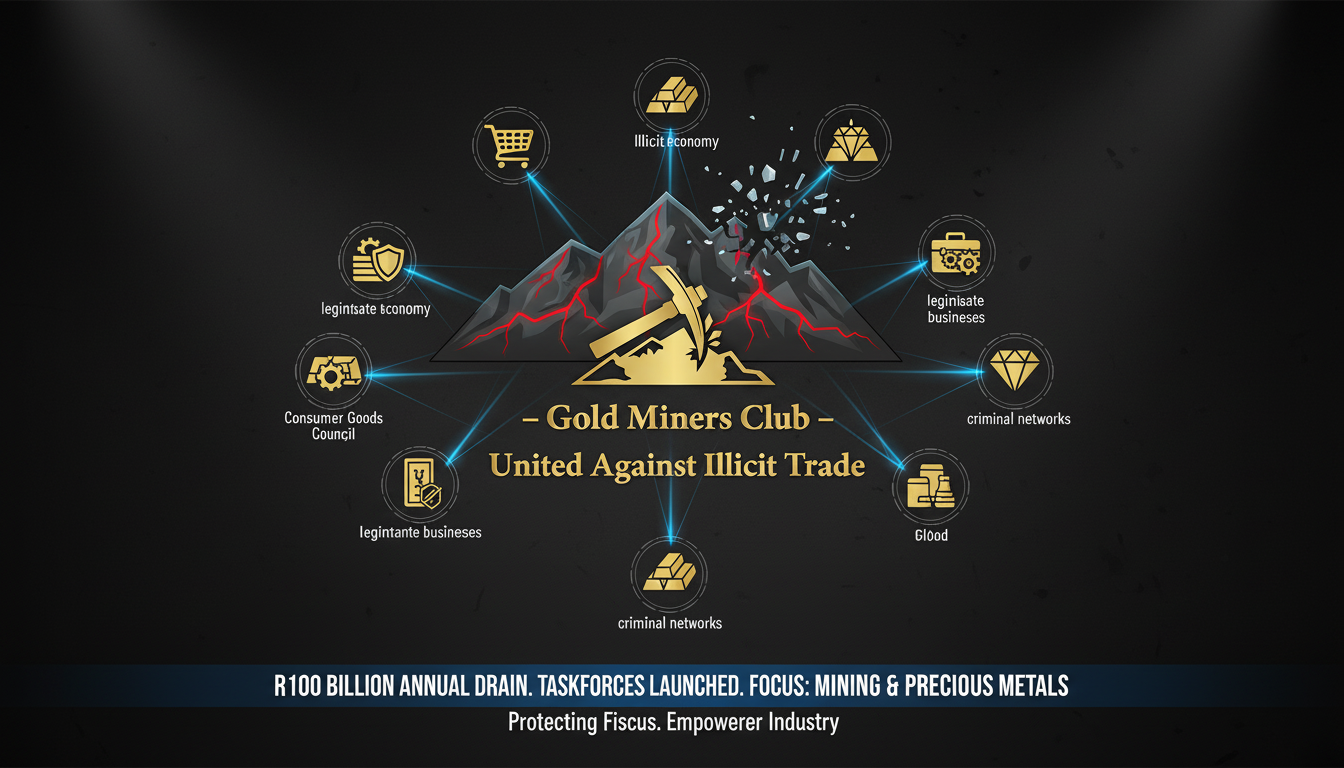
With the illicit economy draining an estimated R100 billion from the fiscus each year, the Consumer Goods Council of South Africa has created multi-industry taskforces to disrupt criminal networks and protect legitimate businesses—now broadening their focus to the mining and precious metals sector.
In December 2025, the Consumer Goods Council of South Africa (CGCSA) announced the establishment of multi-industry illicit economy task forces, marking a significant escalation in the private sector’s fight against organised crime. The initiative brings together brand owners, retailers, manufacturers, logistics providers, and industry leaders across multiple sectors in a coordinated effort to restore integrity to the Fast-Moving Consumer Goods (FMCG) sector and beyond.
“These illegal activities undermine legitimate businesses, deplete tax revenues, undermine international trade and exacerbate social and economic inequalities,” the Transnational Alliance to Combat Illicit Trade noted in its 2025 review of South Africa.
The Scale of South Africa’s Illicit Trade Crisis:
The CGCSA estimates that the illicit economy accounts for about 10% of South Africa’s GDP. The government loses R100 billion a year in excise duties and VAT, and Business Leadership South Africa estimates that illicit trade costs R250 million per day.
The tobacco sector faces high illegal activity—up to 74.5% of cigarettes are illicit, costing between R18 and R28 billion in annual tax losses.
Legitimate manufacturers, who must pay at least R26.22 in excise tax per pack, struggle to compete with smuggled cigarettes retailing for as little as R10 to R20 per pack. The result has been devastating: British American Tobacco announced it would close its only cigarette manufacturing plant in the country, threatening 35,000 jobs across the industry.
The illicit alcohol trade presents another significant challenge. The CGCSA estimates illegal alcohol sales cost the country an estimated R16.5 billion in lost revenue in 2024—13 times the amount Treasury expected to raise from above-inflation excise increases in 2025/26. The liquor industry now estimates that illegal sales account for nearly 20% of total alcohol consumption.
The Mining and Precious Metals Crisis:
The illicit mining sector has emerged as one of South Africa’s most pressing criminal enterprises, with devastating economic and social consequences. The South African government estimates that illicit mining and the illegal trade in precious metals cost the economy more than R60 billion annually in lost revenue, royalties, and export earnings.
Illegal gold mining, known locally as “zama zama” operations, has proliferated across the country’s gold belt, particularly in the provinces of Gauteng, Mpumalanga, and North West. The South African Police Service estimates that approximately 6,000 to 8,000 illegal miners are active in abandoned and operational mines at any given time, though some estimates place the number as high as 30,000.
The illicit trade extends beyond gold to include platinum, chrome, manganese, and diamonds. Criminal syndicates have established sophisticated smuggling networks that transport precious metals across South Africa’s borders, often destined for international refining hubs in the Middle East, Asia, and Europe.
“The illicit mining economy is not a victimless crime,” said Mineral Resources and Energy Minister Gwede Mantashe in a March 2026 parliamentary briefing. “It funds organised crime, fuels corruption, results in environmental devastation, and places the lives of illegal miners and surrounding communities at grave risk.”
The human cost has been staggering. In 2025 alone, more than 200 illegal miners died in underground incidents, including collapses, fires, and violent clashes between rival syndicates. In February 2026, rescue operations recovered the bodies of 47 illegal miners from a disused mine shaft in Randfontein following a suspected gas inhalation incident.
The South African Revenue Service has identified precious metals smuggling as one of the fastest-growing vectors of illicit trade, with criminal networks exploiting porous border posts and corrupt customs officials to move gold and platinum out of the country without paying royalties or export duties.
A Coordinated Response:
The CGCSA’s task forces are designed to implement a coordinated approach to dismantle illicit trade networks, focusing on the most affected product categories: liquor, tobacco, food, cosmetics and pharmaceuticals, clothing, toys, and now mining and precious metals.
“We have launched Illicit Economy Task Forces to press for urgent interventions from Government, Parliament and the collective Nedlac social partners,” the CGCSA stated in February 2026. “These Task Forces, which include brand owners, retailers, manufacturers, logistics providers and leaders across multiple sectors, are mobilising to advance a secure and legitimate South African economy. Yet business cannot do this alone.”
CGCSA Chief Executive Officer Zinhle Tyikwe underscored the urgency of the situation in December 2025: “There is no doubt that illicit trade is one of the most significant threats facing South Africa and is also a threat to economic stability, investment, job creation and governance. This challenge now requires decisive, collective and multi-faceted action. We urge all stakeholders—government, business, and civil society—to join forces with the CGCSA and actively support the fight against illicit trade by participating in initiatives, reporting suspicious activities, and advocating for stronger enforcement measures.”
The mining industry has responded with coordinated efforts of its own. The Minerals Council South Africa launched the Precious Metals Combatting Illicit Trade Initiative in January 2026, bringing together major mining houses, refining companies, and security experts to develop technology-driven solutions for tracking gold and platinum from mine to export.
“We are deploying advanced traceability technologies, including isotopic fingerprinting and blockchain-based provenance systems, to ensure that every ounce of precious metal leaving South Africa can be verified as legitimately mined,” said Minerals Council CEO Mzila Mthenjane in February 2026.
Government Joins the Fight:
The private sector’s initiative has found resonance at the highest levels of government. In his February 2026 State of the Nation Address, President Cyril Ramaphosa devoted significant attention to the crisis, announcing the establishment of a National Illicit Economy Disruption Programme.
“We are addressing the threat posed by the infiltration of illegal and counterfeit goods to South African jobs and industry. We are establishing a National Illicit Economy Disruption Programme that brings together key state agencies and other stakeholders, including the private sector. Through effective use of data analytics and Artificial Intelligence, we will target high-risk sectors like tobacco, fuel, alcohol, mining, and other counterfeit products,” Ramaphosa said.
The programme, officially named Operation Ukubusa, is scheduled for launch on April 1, 2026. Its coordination will be overseen by the Justice, Crime Prevention and Security (JCPS) cluster, with the visible policing division of the South African Police Service—led by the section head for Emerging Economic Crime—responsible for operational coordination.
A specialised unit within the Hawks, the National Priority Committee on Precious Metals and Diamonds, has been reinforced with additional investigators and intelligence analysts to target the syndicates controlling illicit mining networks.
The government has established clear measurable indicators to assess the programme’s effectiveness, including the disruption and dismantling of organised criminal networks, the seizure of illicit goods, arrests and prosecutions associated with economic crimes, the recovery of revenue and assets, and the enhancement of border security.
Tangible Results on the Ground:
The intensified focus on illicit trade is already yielding concrete results. In the week ending March 29, 2026, police operations led to the seizure of counterfeit goods worth more than R160 million across various parts of the country.
In the mining sector, a multi-agency task force conducted a major operation in the West Rand on March 22, 2026, resulting in the arrest of 124 suspected illegal miners and the seizure of gold-bearing material valued at approximately R45 million. The operation, which involved the SAPS, Hawks, and the South African National Defence Force, also uncovered an illicit gold processing laboratory equipped with smelting furnaces and chemical processing equipment.
The National Counterfeit and Illicit Goods Unit led a joint takedown operation in Bellville on March 24, 2026, resulting in the seizure of counterfeit goods worth more than R117 million. A multi-agency task force confiscated over 130,000 fake items, including branded clothing, sports apparel, sneakers, caps, sunglasses, and watches.
In Gauteng, authorities shut down a counterfeit manufacturing plant operating in a medical building in Johannesburg’s central business district, seizing goods and printing machines valued at R28 million. In KwaZulu-Natal, a large shipment of fake cigarettes worth over R15 million was also taken.
The South African Revenue Service has also intensified its efforts, focusing specifically on corruption within government departments. SARS Commissioner Edward Kieswetter announced that search-and-seizure operations are targeting customs officials allegedly colluding with clearing agents and importers to facilitate the smuggling of precious metals and illicit goods.
“SARS has been investigating allegations that customs-inspection teams colluded with clearing agents and importers to manipulate physical inspections in exchange for cash bribes. Financial analysis identified under-declared taxable income exceeding R45 million, resulting in income tax prejudice of about R18 million,” the revenue service reported.
At South Africa’s borders, the Border Management Authority has deployed additional personnel and advanced scanning technology to intercept illicit precious metals leaving the country. In the first quarter of 2026, authorities seized more than 350 kilograms of illegally sourced gold and platinum with an estimated value of R320 million.
A Multi-Pronged Strategy:
The CGCSA has called for the adoption of GS1 standards as a cornerstone of the fight against the illicit economy. These globally recognised standards, already embedded across supply chains in more than 120 countries, serve as the backbone of traceability, transparency, and enforcement.
For the mining sector, the Minerals Council is advocating for mandatory implementation of the Kimberley Process Certification Scheme for diamonds and the development of similar certification mechanisms for gold and platinum. These systems would require that all precious metal exports be accompanied by verifiable documentation tracing the commodity from a legitimate mining operation to the point of export.
By enabling unique product identification, standardised data capture, and interoperable information sharing, these standards empower regulators, law enforcement, and businesses to close loopholes exploited by illicit operators. The standards strengthen enforcement through data-driven monitoring and analytics, protect consumers by verifying the authenticity and safety of goods, and secure fiscal revenue by ensuring legitimate trade flows are visible and accountable.
The government’s strategy extends beyond enforcement to encompass broader economic reforms. Cabinet has placed the fight against organised crime and the multibillion-rand illicit economy at the centre of its strategy to reduce unemployment and accelerate economic growth, arguing that criminal syndicates are undermining investment, destroying jobs, and draining the fiscus.
Minister in the Presidency Khumbudzo Ntshavheni emphasised this connection in February 2026: “You cannot have an economy that grows without fighting crime. Organised crime has been a major challenge, and that’s why the interventions have been made to fight organised crime.”
The Road Ahead:
As Operation Ukubusa prepares for its April 1 launch, the CGCSA continues to press for genuine multi-stakeholder collaboration. The effectiveness of these efforts, the council notes, depends on the Nedlac social partners collectively driving enforcement, aligning policy, and closing systemic gaps.
ActionSA has also sought formal inclusion in the national task team established to combat illicit trade, requesting participation in a “constructive and non-partisan spirit” to contribute expertise and strengthen oversight.
“South Africans deserve to know what revenue recovery targets have been set, which departments and entities are accountable, and how progress will be reported to Parliament,” the party stated in March 2026.
The stakes could not be higher. As the CGCSA warned, the illicit economy is eroding South Africa’s economy and destroying legitimate industries. “This is not just lost revenue; it is livelihoods, public safety, and national stability under attack. The National Illicit Disruption Programme is the wake-up call the country needs and a positive response to a scourge which has become a national crisis.”
With the combined forces of the CGCSA’s industry taskforces, the government’s Operation Ukubusa, enhanced enforcement by SAPS and SARS, and the mining sector’s dedicated anti-illicit trade initiatives, South Africa is mounting what may be its most coordinated and determined effort yet to reclaim its economy from the grip of illicit trade across all sectors—from consumer goods to precious metals.
News References
- Consumer Goods Council of South Africa (CGCSA). (2025, December). CGCSA Launches Multi-Industry Illicit Economy Task Forces. Press Release. Johannesburg.
- Transnational Alliance to Combat Illicit Trade (TRACIT). (2025). Illicit Trade in South Africa: A Threat to Economic Stability and Governance. TRACIT Policy Brief.
- Ramaphosa, C. (2026, February 10). State of the Nation Address 2026. Parliament of the Republic of South Africa, Cape Town.
- South African Police Service (SAPS). (2026, March 29). Operation Ukubusa: Weekly Operational Update – Counterfeit Goods Seizures Exceeding R160 Million. SAPS Media Statement. Pretoria.
- South African Revenue Service (SARS). (2026, March 25). SARS Intensifies Crackdown on Customs Corruption and Illicit Trade. SARS Media Release. Pretoria.
- Mantashe, G. (2026, March 12). Parliamentary Briefing on Illicit Mining and Precious Metals Smuggling. Mineral Resources and Energy Portfolio Committee. Cape Town.
- Minerals Council South Africa. (2026, January 28). Precious Metals Combatting Illicit Trade Initiative Launch. Media Statement. Johannesburg.
- Mthenjane, M. (2026, February 19). CEO Address: Technology-Driven Solutions for Combatting Illicit Mining. Minerals Council Annual Conference. Sun City.
- Hawks – Directorate for Priority Crime Investigation. (2026, March 23). *West Rand Anti-Illicit Mining Operation: 124 Arrests, R45 Million in Gold-Bearing Material Seized*. Media Release. Pretoria.
- Border Management Authority (BMA). (2026, April 1). First Quarter 2026 Border Seizures Report: Precious Metals and Illicit Goods. BMA Quarterly Briefing. Pretoria.
- Ntshavheni, K. (2026, February 12). Post-Cabinet Media Briefing: Fight Against Organised Crime Central to Economic Growth. Government Communication and Information System (GCIS). Pretoria.
- ActionSA. (2026, March 18). ActionSA Seeks Inclusion in National Task Team to Combat Illicit Trade. ActionSA Parliamentary Statement. Johannesburg.
- Business Leadership South Africa (BLSA). (2026, January 15). BLSA Economic Update: The Daily Cost of Illicit Trade. BLSA Briefing Note. Johannesburg.
- Tyikwe, Z. (2025, December 8). CEO Address: The Illicit Economy as a Threat to FMCG Stability. Consumer Goods Council of South Africa Annual Summit. Sandton.
- National Treasury of the Republic of South Africa. (2026, February 24). Budget Review 2026: Revenue Losses Due to Illicit Trade. Government Printing Works. Pretoria.