
By: GOLD MINERS CLUB
For decades, Guinea was dismissed as a “geological scandal” trapped in a “political tragedy.” Home to the world’s largest reserves of high‑grade bauxite and the biggest untapped iron ore deposit—Simandou—Guinea was always on the brink of economic transformation that never came. Corruption, military interventions, and poor infrastructure kept its wealth buried.
That narrative began to shift after Colonel Mamady Doumbouya seized power in September 2021. In response, the military junta initiated a so-called “mining revolution” marked by radical changes: an overhaul of ownership rules, local-processing mandates, and increased state oversight. Five years later, Guinea is positioned to become a global iron ore powerhouse. While the revolution has produced measurable gains, it has also exacerbated political fragility, straining international investors’ patience and deepening Guineans’ uncertainty about whether mineral wealth will translate into broad-based prosperity.
Simandou: From Curse to Cornerstone:
The centerpiece of the revolution has always been the Simandou mountain range in the country’s southeast. However, for a quarter of a century, the project was paralyzed by legal battles and corruption scandals. Furthermore, a $15‑billion infrastructure hurdle—requiring a 670-kilometer railway and a Deepwater port—stood in the way. As a result, no single company was willing to finance the project on its own.
The junta broke the deadlock in 2022 with an ultimatum: build or lose your permits. By late 2025, the infrastructure was complete. In February 2026, the Rio Tinto-led and Chinese-backed Winning Consortium Simandou (WCS) announced that the first iron ore had been railed to the new port at Morebaya.
“Simandou is no longer a geological fantasy; it is a functioning industrial complex,” Mines Minister Bouna Sylla said at a ceremony in Conakry. “Guinea is now a player that will reshape the global iron ore market.”
Analysts project that, by 2027, Guinea’s annual exports will reach 120 million tonnes, directly challenging the dominance of Australia and Brazil. The Guinean government currently holds a 15% free-carry interest in the project with an option to increase its stake; this arrangement exemplifies the junta’s resource-nationalist strategy.
Local Refining: A Mandate Under Strain:
The revolution’s second pillar—mandating local processing of bauxite into alumina—has proved more contentious. In 2022, the junta decreed that all bauxite miners must build refineries inside Guinea, ending the decades‑old practice of shipping raw ore to China.
By 2026, the policy’s effects are uneven. A $1.5‑billion refinery backed by Chinese firms TBEA and Shandong Weiqiao began operations in January 2026 in Boké, reflecting some compliance. In contrast, key multinationals resisted government demands. Emirates Global Aluminum (EGA), which operates the Guinea Alumina Corporation (GAC) mine, has withheld investment in the refinery, citing prohibitive capital costs—estimated at $3–4 billion—and unreliable power. Despite protracted, unresolved negotiations and repeated government extensions for EGA, the Mines Ministry restated in March 2026 that bauxite exporters must submit binding refinery construction timelines by year’s end, signaling credible threats of future export restrictions.
Russia’s RUSAL, another major bauxite producer, has also come under pressure. In February 2026, the government briefly suspended RUSAL’s exports from its Fragua complex, accusing the company of falling behind on its local‑processing commitments. The suspension was lifted after Moscow intervened diplomatically. This episode underscored how the refinery policy has become entangled with political bargaining.
Energy shortages have directly undermined Guinea’s industrialization drive. The aging of hydroelectric dams and frequent blackouts have reduced output at new refineries, indicating a misalignment between industrial ambitions and the energy sector’s preparedness.
The Geopolitical Pivot: Russia and China Deepen Ties:
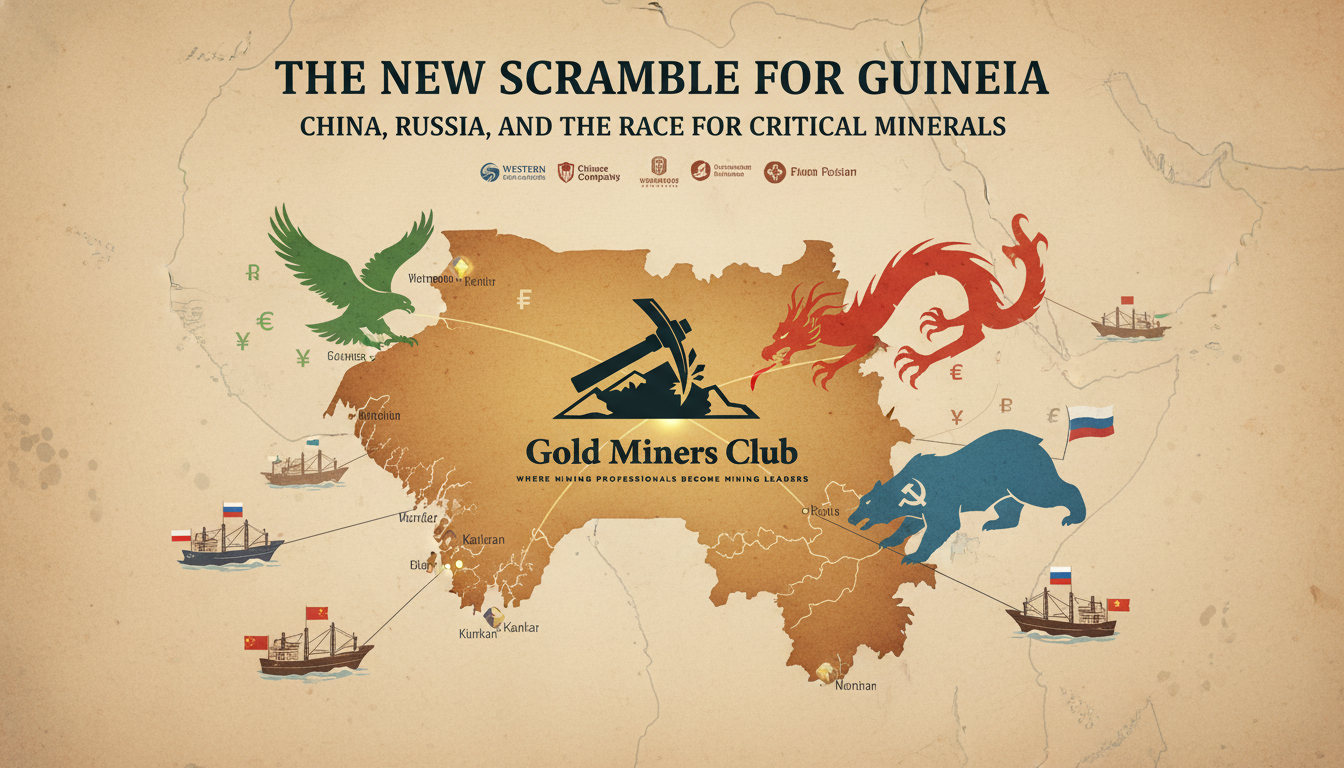
The junta’s “revolution” has precipitated a marked realignment in foreign partnerships. Western mining executives, citing inconsistent contract enforcement, signal growing uncertainty. In contrast, Chinese and Russian state-linked firms have systematically expanded their market presence.
In January 2026, Colonel Doumbouya traveled to Moscow for his third meeting with President Vladimir Putin since taking power. The two leaders announced a “strategic minerals partnership.” It includes Russian investment in Guinea’s energy infrastructure and a long‑term alumina off‑take agreement. The deal was widely seen as support for RUSAL. The company has experienced pressure from Western sanctions and now relies heavily on its Guinean operations.
China, meanwhile, has consolidated its position as the dominant financier. The Chinese Export-Import Bank’s provision of most loans for the Simandou railway and port, combined with Chinese firms’ control of approximately 45% of Guinea’s bauxite production, underscores Beijing’s expanding leverage. This increasing economic dependence has prompted officials in Washington and Brussels to warn that Guinea’s debt profile is becoming dangerously concentrated toward China.
Political Uncertainty: The Elusive Return to Civilian Rule:
While Guinea’s mining sector advances, the political transition remains stalled. Although the junta pledged to restore civilian rule by the end of 2024, Doumbouya revealed in a televised address on December 31, 2025, that a “new transition timeline” is necessary, explicitly tying this delay to the imperative of maintaining stability as Simandou production begins.
Opposition parties and civil society groups accuse the junta of using mining as a pretext to entrench its rule. In February 2026, security forces cracked down on a Conakry protest organized by the National Front for the Defense of the Constitution (FNDC), injuring several demonstrators.
The Economic Community of West African States (ECOWAS) has maintained targeted sanctions on the junta but has stopped short of imposing a broad embargo, underscoring a pragmatic calculation that the mining boom’s strategic value outweighs the risks of a total rupture.
Social Strains: Displacement and Unrealized Expectations
Guinea’s mining transformation has imposed a high social cost. Construction of the Simandou railway and alumina refinery displaced about 12,000 people, according to a March 2026 Human Rights Watch (HRW) report. HRW documented forced evictions in Forécariah and Nzérékoré. Residents called compensation insufficient and irregular.
“They told us the railway would bring prosperity, but we lost our farms, and we have not seen any jobs,” a village chief in Forécariah told HRW researchers.
The government has defended its resettlement programs, citing a $200 million fund from Simandou partners. However, independent observers note slow disbursement and opaque oversight.
Looking ahead, as the first quarter of 2026 draws to a close, Guinea’s mining revolution remains at a crossroads. The junta has achieved what its civilian predecessors could not: Simandou is finally producing, and some local refineries are beginning to alter the country’s role from a raw‑material exporter to an industrial player.
As the first quarter of 2026 ends, Guinea’s mining revolution stands at a crossroads. The junta has achieved what its civilian predecessors could not: Simandou is producing. Local refineries are beginning to shift the country’s role from a raw-material exporter to an industrial player.
Yet the foundations of the transformation are precarious. The government’s heavy‑handed approach—ultimatums, retroactive contract adjustments, and the politicization of mining permits—has created a legal environment of uncertainty. Arbitration cases filed by international investors are pending at the International Center for Settlement of Investment Disputes (ICSID), and some Western firms are quietly exploring portfolio reductions.
Moreover, the delayed political transition threatens to undermine the very stability that the junta says is necessary for the mining sector to flourish. Without credible elections and a restoration of constitutional order, observers warn that Guinea risks squandering the historic opportunity that Simandou represents.
“The mining revolution has revealed Guinea’s vast resource potential but has yet to deliver a social contract that ensures equitable benefit-sharing,” said a Conakry-based political analyst who requested anonymity. “Absent tangible gains for ordinary Guineans, the instability that once impeded growth may soon return, threatening the sustainability of recent investments.”
References:
- “Simandou delivers first ore as Guinea reshapes global iron ore trade,” Reuters, February 10, 2026.
- “Guinea’s alumina refinery push hits power snags as RUSAL standoff eases,” Bloomberg, March 5, 2026.
- “EGA stalls on Guinea refinery as junta renews ultimatum,” Reuters, March 18, 2026.
- “Guinea deepens Russia ties with minerals deal as Doumbouya visits Moscow,” Financial Times, January 28, 2026.
- “China tightens grip on Guinea’s mining sector as Simandou reaches output,” The Wall Street Journal, March 12, 2026.
- “Guinea junta delays return to civilian rule as Simandou production begins,” Associated Press (AP), January 2, 2026.
- “ECOWAS keeps Guinea sanctions in place but softens tone amid mining boom,” Al Jazeera, February 18, 2026.
- “Guinea: Mining mega‑projects leave displaced communities in limbo,” Human Rights Watch, March 24, 2026.
- “Guinea’s mining gamble: Simandou success masks deepening political risks,” Africa Confidential, March 19, 2026.