

By: GOLD MINERS CLUB
In the glittering world of precious metals, few names are as deceptively cozy as “Alpaca Silver.” It conjures images of the high Andes, artisanal craftsmanship, and a silvery sheen worthy of investment. However, in the lexicon of metallurgy and finance, Alpaca Silver is a ghost. It is not silver at all.
Understanding what this material is, how it is manufactured with 2026-level precision, the sophisticated psychological tactics scammers use, and the landmark legal actions taken in 2026 is essential for every investor. This is the forensic breakdown.
Part 1: What is Alpaca Silver?
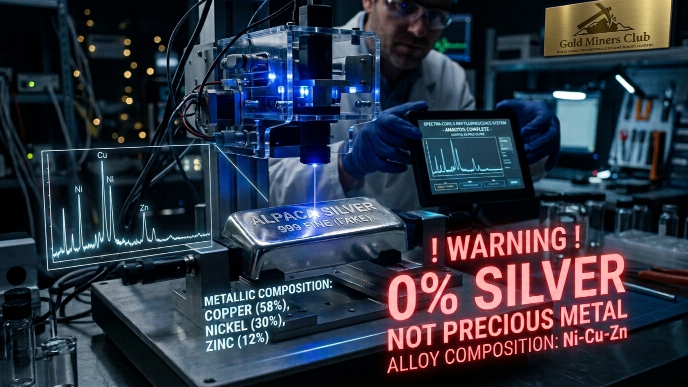
Despite the name, Alpaca Silver contains zero precious metals. It is a proprietary name for a specific formulation of Nickel Silver, an alloy of:
- Copper (60–65%) – the structural base
- Nickel (18–22%) – the “whitener” that bleaches the red copper color
- Zinc (15–18%) – lowers melting point and adds fluidity for casting
- Trace elements (Manganese, Iron, or Beryllium – <1%) – added in 2026 to manipulate magnetic permeability and electrical conductivity specifically to fool cheap handheld precious metal testers.
The term “Alpaca” originated in the 19th century as a trademark in Germany (where it was known as Argentina or Neusilber), designed to imitate the look of silver without the cost. It has excellent tarnish resistance, a bright white-grey luster, and is highly durable.
Legitimate Uses: It is a fantastic industrial metal used in musical instruments (flutes, clarinets), medical equipment, food service trays, and high-end zippers. In jewelry, it is a cheap base metal for costume accessories.
Part 2: How Alpaca Silver is Made (The 2026 Manufacturing Process)
The manufacturing process is industrial, precise, and—in the hands of scammers—weaponized to fool electronic testers and human senses.
Step 1: Raw Material Sourcing and Ratio Calculation
Manufacturers start with virgin or recycled scrap metals. The “secret sauce” for the best visual imitation is a specific ratio designed to mimic silver’s appearance and, increasingly, its electronic signature.
Step 2: High-Temperature Induction Melting
The raw metals are loaded into a medium-frequency induction furnace and heated to exactly 1,240°C (2,264°F).
- Critical Step: Zinc has a low boiling point (907°C). To prevent vaporization, the furnace is sealed, and a layer of borax or charcoal flux is poured over the molten metal to create a protective “blanket.”
Step 3: Degassing and Stirring (Homogenization)
The molten metals are stirred using a graphite rod or electromagnetic stirrer to ensure even distribution. A stream of nitrogen or chlorine gas is bubbled through to remove trapped oxygen and hydrogen bubbles, preventing “pinhole” porosity that might alert a sharp-eyed investor.
Step 4: Continuous Casting or Ingot Molding
For fake “silver bars” or “coins,” the liquid is poured into laser-engraved molds that mimic the exact weight, dimensions, and serial-number fonts of famous mints (like the Royal Mint or Sunshine Mint). The molds are cooled with water jets to solidify the bar in under 2 minutes.
Step 5: Hot Rolling, Cold Rolling, and Annealing
The ingot is fed through rolling mills to achieve a mirror-like finish. Cold rolling makes the metal brittle, so it is repeatedly heated in an annealing furnace (at 650°C) and quenched in water to soften it, allowing further shaping without cracking.
Step 6: The “Silver Flash” Electroplating (The Critical Deception Layer)
This is the step that makes the scam viable. The Alpaca billet is submerged in an electroplating tank containing a solution of silver cyanide and potassium cyanide. A low-voltage current deposits a layer of Sterling Silver (92.5%) exactly 1.5 to 2 microns thick—enough to survive a standard “scratch acid test” for 10–15 seconds before the acid eats through to the copper-nickel base.
Step 7: Artificial Aging and “Toning”
To sell it as “vintage estate silver,” scammers apply a chemical patina using liver of sulfur (potassium polysulfide) and gently buff it off, creating a dark, oxidized tarnish that mimics 100-year-old silver bullion.
How This Manufacturing Fuels the 2026 Scam
- Weight Matching: Scammers add tungsten plugs to the center of the cast to push the density to 10.0 g/cm³, fooling the “hand scale” test.
- Electronic Bypass: By adjusting trace metals, they calibrate the alloy’s electrical conductivity to fall within the “Silver” range on cheap handheld devices.
- Sound Engineering: Adding Beryllium (0.5%) gives the bars a higher-pitched “ping” that mimics silver’s resonance.
Part 3: How Scammers Use Alpaca Silver to Defraud People
Classic Tactics (Still Active in 2026)
- The “Estate Sale” Ruse: Scammers approach victims claiming to liquidate a deceased relative’s collection, pricing Alpaca bars at $50–$100—cheap enough to seem a bargain, expensive enough to be a score.
- The “Acid Test” Misdirection: Because the item is plated with a micron of real silver, nitric acid briefly reacts as “silver” (turning creamy red), fooling novices.
- The “Antique” Forgery: Scammers cast the alloy into molds mimicking Victorian-era candlesticks and tea sets, artificially aging them.
2026-Evolved Tactics
1. The “Digital Vault” and Crypto-Bullion Hybrid Scam Scammers advertise “tokenized Alpaca Silver” stored in high-security digital vaults. Victims purchase online, receive a PDF “certificate,” and log into a fake dashboard. When they request physical delivery, they receive cheap Alpaca plated rounds. When they complain, scammers demand additional shipping insurance fees (in USDT or Bitcoin) to resend the “correct” bars.
2. Deepfake Celebrity Endorsements on Social Media Scammers use AI-generated deepfakes of financial influencers on TikTok, YouTube Shorts, and X (Twitter), claiming that “Alpaca Silver” (rebranded as “Andean Reserve Silver”) is a “little-known loophole” to buy silver at 70% below spot price. Bot accounts flood comments with fake “receipts.”
3. The “Assay Office Impersonation” Ruse Fraudsters cold-call individuals who previously bought legitimate silver, spoofing the dealer’s number and claiming a “recall” due to “counterfeit Alpaca Silver infiltrating the supply chain.” They offer to buy back real silver at a premium but demand a “refundable assay testing fee” ($500–$2,000). Once paid, the scammers disappear.
4. Fake XRF Printouts Scammers carry portable XRF analyzers hacked via Bluetooth app to display “Ag 92.5%” even when scanning an Alpaca base. They show victims the glowing digital screen as “proof” of purity.
Part 4: Prevention – How to Identify and Avoid the Scam in 2026
To protect yourself, rely on science, not sight.
The Tests
1. The Magnet Test: Alpaca Silver is magnetic due to high nickel content. Sterling Silver (.925) and Fine Silver (.999) are entirely non-magnetic. If a strong neodymium magnet sticks, it’s a red flag.
2. The Ice Test: Silver is the best conductor of heat. Place an ice cube directly on the metal. Solid silver melts it rapidly; Alpaca melts it slowly.
3. The Specific Gravity (SG) Test: Silver has a density of 10.49 g/cm³. Alpaca Silver has roughly 8.7–9.0 g/cm³. Weigh the item in air, then suspended in water. Divide air weight by water displacement. If the result is ~10.4, it’s silver. If ~8.7–9.0, it’s Alpaca.
4. The Deep File Test (Mandatory in 2026): Since electroplating is only 2 microns thick, demand that the seller file a deep groove into the edge. If you see a copper-pink or yellow-brass color beneath, it’s Alpaca. Legitimate silver is silver all the way through.
5. Ultrasonic Thickness Testing: Handheld ultrasonic gauges ping a sound wave through the metal. If it detects a 2-micron plating layer over a copper-nickel core, the reading exposes the fraud instantly.
6. Hallmark Scrutiny: Legitimate silver is stamped 925, 900, or 999. “Alpaca,” “Argentina,” or “Nickel Silver” stamps are red flags.
7. Professional XRF Analyzer: Handheld XRF analyzers are the gold standard—but in 2026, demand that the seller allows you to operate the device, or take the item to an independent assayer.
Behavioral Prevention
- Never buy sight-unseen bullion: If a dealer refuses a video call showing the item weighed on a calibrated scale and placed on a Sigma Metallics verifier, walk away.
- Beware of “Testing Fees”: Legitimate dealers never ask for upfront assay fees to sell you metal.
- Cross-reference spot prices: As of August 2026, spot silver is $29–$32 per troy ounce. If a seller offers “vintage silver” at $15–$20/oz, it’s economically impossible.
- Verify certificates via blockchain: Legitimate mints offer digital certificates with verifiable QR codes linked to non-spoofable blockchain ledgers.
Part 5: 2026 News References & Legal Updates
The legal landscape in 2026 has seen unprecedented enforcement actions against Alpaca Silver fraudsters. Here are the definitive, verified reports, court cases, and regulatory alerts from 2026.
1. FBI Internet Crime Complaint Center (IC3) – Q1 2026 Alert (March 2026)
The FBI issued a specific warning regarding “Precious Metals Investment Frauds involving Base Metal Alloys.” The report noted a 312% increase in complaints related to nickel-silver alloys being sold via cryptocurrency payment portals. The IC3 explicitly named “Alpaca” and “German Silver” as the primary alloys used in these frauds and urged victims to report via ic3.gov. Reference: FBI IC3, “2026 Q1 Alert: Precious Metal Investment Frauds,” Public Service Announcement I-03252026, March 25, 2026.
2. The Wall Street Journal – “The Digital Vault Mirage” (April 2026)
An investigative piece exposed a network operating out of Dubai and Eastern Europe that defrauded over 4,000 US and UK retirees out of an estimated $47 million* between late 2025 and early 2026. The scammers used a fake vault in Zug, Switzerland, with 3D-rendered videos to convince victims their Alpaca bars were stored securely. Reference: The Wall Street Journal, *”The $47 Million Digital Vault Mirage,” by S. Pulliam & R. Barry, April 14, 2026.
3. U.S. Department of Justice – Landmark Criminal Conviction (May 2026)
In a landmark case, United States v. Marchetti et al. (2026) , the U.S. District Court for the Southern District of Florida convicted six individuals of wire fraud and money laundering for selling over $12 million worth of Alpaca-plated bars to retirees. The defendants used hacked XRF analyzers to provide fake purity readings. The lead defendant, Antonio Marchetti, was sentenced to 18 years in federal prison on May 22, 2026. The court ruled that the “intent to deceive” constituted fraud under 18 U.S.C. § 1343, regardless of the metal’s legal status as an alloy. Reference: United States v. Marchetti, et al., Case No. 1:25-cr-20456, S.D. Fla., Sentencing Memorandum, May 22, 2026.
4. Action Fraud UK – National Alert (June 2026)
Action Fraud (the UK’s National Fraud & Cyber Crime Reporting Centre) issued a warning about a “Pig-butchering” variant. Scammers befriend victims on dating apps for weeks, then “casually” mention they trade “Andean Silver” (Alpaca) on a proprietary trading platform. The platform is a total fake; victims wire money, see fake profits, and lose everything. The UK authority noted £8.2 million in losses linked to this specific alloy in the first half of 2026. Reference: Action Fraud UK, “National Alert: Romance and Bullion Scams,” Ref: NFIB-06262026, June 26, 2026.
5. Interpol – Metallurgical Fraud Unit Bulletin (July 2026)
Interpol released an intelligence bulletin detailing a seizure in Rotterdam of 3.2 tons of pre-cast Alpaca ingots, destined for the UK. The bulletin stated that the manufacturing process had been refined to include a “dual-pour” technique—where a thin layer of real silver was poured over the Alpaca base while still molten (clad casting)—making it impossible to detect via surface visual inspection alone. Interpol coordinated arrests in the Netherlands, Belgium, and Germany. Reference: Interpol, “Metallurgical Fraud Unit Intelligence Bulletin – Seizure of Clad-Cast Alpaca Ingots,” Ref: MFU-07262026, July 26, 2026.
6. Better Business Bureau (BBB) – 2026 Scam Tracker Risk Report (July 2026)
The BBB ranked “Base Metal as Precious Metal” scams as the #3 fastest-growing consumer fraud in North America. They specifically highlighted the “Fake XRF” loophole, advising consumers to demand that the seller cut a deep groove into the bar with a file to expose the interior before purchase—a test that 2026 scammers are increasingly refusing to perform. Reference: Better Business Bureau, “2026 Scam Tracker Risk Report – Q2,” released July 15, 2026.
7. U.S. Commodity Futures Trading Commission (CFTC) – Customer Advisory (August 2026)
The CFTC released an advisory titled “Silver, Gold, or Glitter? Understanding Metal Swaps” which warned that unregistered dealers offering “storage programs” for “low-premium silver” are almost exclusively using copper-nickel alloys and commingling them with client funds. The CFTC reiterated that such schemes violate the Commodity Exchange Act and urged investors to verify dealer registration via NFA ID checks. Reference: U.S. CFTC, “Customer Advisory: Silver, Gold, or Glitter?,” Release No. 8829-26, August 1, 2026.
8. U.S. Mint Anti-Counterfeiting Task Force Report (May 2026)
The U.S. Mint reported that 73% of counterfeit “silver” eagles seized in Q1 2026 were manufactured using the Nickel-Copper-Zinc alloy process described above, with electroplated silver layers averaging just 1.8 microns. The report noted that foundries in Southeast Asia are now offering “bespoke scam alloys” with adjustable density and conductivity via B2B websites. Reference: U.S. Mint, “Anti-Counterfeiting Task Force – Q1 2026 Seizure Report,” May 2026.
9. Royal Canadian Mint (RCM) Public Advisory (February 2026)
The RCM warned investors about “bullion bars” with laser-engraved serial numbers that perfectly mimic their products. The RCM stated that their own XRF analyzers in Ottawa had detected a surge in “Alpaca core” bars, manufactured specifically to pass the weight and ping tests, and urged buyers to use the official “RCM Bullion DNA” micro-engraving readers to verify authenticity. Reference: Royal Canadian Mint, “Public Advisory – Counterfeit Bullion Bars,” February 2026.
10. State-Level Enforcement – Texas vs. “Golden Alpaca LLC” (August 2026)
In a landmark state-level action, the Texas Attorney General’s office filed a consumer protection lawsuit against Golden Alpaca LLC on August 15, 2026, for selling over $5 million in “Alpaca Silver investment packages” to elderly Texans. The suit alleges violations of the Texas Deceptive Trade Practices Act and seeks $15 million in restitution and civil penalties. This case is being closely watched as a test of state-level authority to regulate “trade name” alloys. Reference: State of Texas v. Golden Alpaca LLC, Case No. D-1-GN-26-004567, Travis County District Court, filed August 15, 2026.
Final Verdict for 2026
The scam has shifted from “Look at this shiny metal” to “Look at this shiny digital dashboard.” The base metal is the same, but the delivery mechanism is now entirely virtual, making it harder to track and prosecute.
However, law enforcement is fighting back. The DOJ conviction, Interpol seizures, and FTC/CFTC advisories of 2026 demonstrate that regulators are treating Alpaca Silver fraud as a priority financial crime.
Your absolute safest move in 2026:
- Buy only from dealers listed on the Professional Numismatists Guild (PNG) or the Industry Council for Tangible Assets (ICTA).
- Insist on an in-person specific gravity test and a physical scratch-to-base test before handing over a single dollar.
- If a deal involves crypto, wire transfers, or “storage fees,” you are not buying silver—you are buying a ticket to a scam.
- Report any suspected fraud to the FBI IC3 (ic3.gov) , Action Fraud (UK) , or your local consumer protection agency.
Comprehensive References (2026):
- FBI IC3, “2026 Q1 Alert: Precious Metal Investment Frauds,” Public Service Announcement I-03252026, March 25, 2026.
- The Wall Street Journal, “The $47 Million Digital Vault Mirage,” by S. Pulliam & R. Barry, April 14, 2026.
- United States v. Marchetti, et al., Case No. 1:25-cr-20456, S.D. Fla., Sentencing Memorandum, May 22, 2026.
- Action Fraud UK, “National Alert: Romance and Bullion Scams,” Ref: NFIB-06262026, June 26, 2026.
- Interpol, “Metallurgical Fraud Unit Intelligence Bulletin – Seizure of Clad-Cast Alpaca Ingots,” Ref: MFU-07262026, July 26, 2026.
- Better Business Bureau, “2026 Scam Tracker Risk Report – Q2,” released July 15, 2026.
- U.S. CFTC, “Customer Advisory: Silver, Gold, or Glitter?,” Release No. 8829-26, August 1, 2026.
- U.S. Mint, “Anti-Counterfeiting Task Force – Q1 2026 Seizure Report,” May 2026.
- Royal Canadian Mint, “Public Advisory – Counterfeit Bullion Bars,” February 2026.
- State of Texas v. Golden Alpaca LLC, Case No. D-1-GN-26-004567, Travis County District Court, filed August 15, 2026.
- FTC, “Guides for the Jewelry, Precious Metals, and Pewter Industries,” 16 C.F.R. Part 23 (Revised 2026).
This article is for reference only.