
By: GOLD MINERS CLUB
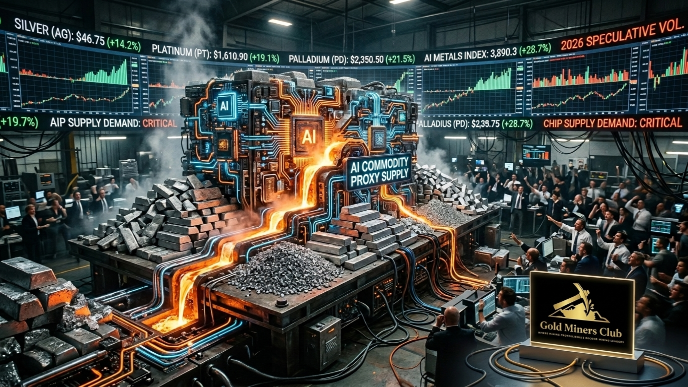
For the better part of two years, financial commentators have warned of a brewing “AI bubble,” drawing parallels to the dot-com crash of 2000. Yet, as we navigate the third quarter of 2026, the speculative frenzy surrounding artificial intelligence is not deflating—it is mutating. While Nvidia’s earnings and Open AI’s valuation remain volatile, a physical manifestation of this digital gold rush is occurring in the commodities market. The AI bubble is no longer just about pixels and processing power; it is about raw materials. In 2026, the price of silver, platinum, and palladium has become a proxy for the health of the global AI supply chain.
The “Physical AI” Squeeze
The narrative has shifted from “software eating the world” to “hardware bottlenecking the world.” The deployment of generative AI at scale requires a massive expansion of data center infrastructure. According to the International Energy Agency (IEA) mid-year report, global data center electricity consumption is projected to reach 1,000 Tw in 2026, double the 2022 figure. However, it is the physical hardware—specifically the connectors, capacitors, and cooling systems—that is driving a surge in demand for metals.
Silver is experiencing the most dramatic repricing. Unlike gold, which serves primarily as a store of value, silver is an industrial workhorse. It is the most electrically conductive metal on Earth, making it irreplaceable in semiconductors, multilayer ceramic capacitors (MLCCs), and high-frequency switching power supplies.
In March 2026, the Silver Institute released its interim report, revising its deficit projection for the year to a staggering 315 million ounces—the largest deficit in modern history. The report specifically cited “unprecedented offtake from the electronics sector, driven by AI server production,” as the primary factor. Spot silver prices touched $36.50 per ounce in early August, up 28% year-to-date, a level not seen since the Hunt Brothers squeeze of 1980. Analysts at Citi have called this a “structural pivot,” noting that while investor flows in silver ETFs have been flat, physical delivery volumes to Asian manufacturing hubs have hit record highs.
Platinum: The Unsung Hero of the Hydrogen Hype
Platinum is playing a more nuanced role. While traditionally tied to the struggling internal combustion engine (as a catalytic converter), the metal is finding a second life in the green hydrogen economy—which AI is inadvertently accelerating.
The logic is cyclical: AI data centers consume enormous power; to meet net-zero pledges, tech giants like Microsoft, Google, and Amazon are purchasing massive volume of green hydrogen for backup power and long-term storage. Platinum is the key catalyst in proton exchange membrane (PEM) electrolyzes.
The World Platinum Investment Council (WPIC) reported in Q2 2026 that demand for platinum from the stationary power sector doubled year-over-year. “The electricity demands of new AI clusters are so intensive that they are forcing developers to look at on-site generation and storage solutions that move away from the grid,” WPIC research director Edward Stack told Reuters in June. “Platinum is the beneficiary of that stress.”
The price reacted accordingly, breaking through the $1,200 per ounce resistance level in July—a psychological barrier it had not held since 2014. It is currently trading at $1,235, driven by the dual narrative of supply constraints (with South African mining output down 5% due to load-shedding issues) and the burgeoning AI-hydrogen nexus.
Palladium: The Recovery Bet
Palladium, often seen as platinum’s poorer cousin in recent years, is staging a surprising comeback. While electric vehicles (EVs) do not require palladium, hybrid vehicles—which are enjoying a resurgence as “transitionary” solutions—do. More importantly, palladium is a critical material in the manufacturing of certain types of MLCCs and is used in the coating of hard disks.
But the real story in 2026 is speculative. As silver and platinum prices soared, hedge funds began rotating into palladium. The commodity has been in a bear market since 2022, and short positions were at record highs at the start of the year. However, a supply shock ignited a short squeeze.
In April, Russia—which supplies roughly 40% of the world’s palladium—signaled a reduction in exports due to maintenance issues at its Norilsk Nickel facilities. Coupled with the AI-driven buying spree, this led to a 40% spike in palladium prices over the summer, hovering around $1,450. While it is far from its all-time high of nearly $3,000, the move was violent enough to cause margin calls for several short sellers.
Valuation or Value?
The critical question for investors is whether this is an asset bubble destined to pop. The “AI bubble” of 2026 differs from the dot-com era in one crucial way: tangible utility.
“There is a floor under these metals that did not exist in the previous tech cycles,” explains commodities strategist Jane Fraser in a recent Goldman Sachs podcast. “In 2000, the internet relied on fiber optics, which are made of sand—cheap and abundant. Today, AI relies on physical physics. You cannot create a cloud without a server, and you cannot run a server without silver. There is a supply deficit that cannot be resolved overnight.”
However, experts warn that the prices may have overshot the earnings. While demand is strong, speculative positioning in the futures market is heavily long. A correction in the tech sector—should AI revenues disappoint—would likely trigger a correlated sell-off in industrial metals. The correlation coefficient between the Nasdaq and Silver has risen to 0.75 in 2026, up from 0.3 in 2020, suggesting that the metals are now seen as risk-on assets rather than pure safe havens.
The Tipping Point
As we look toward the end of 2026, the Federal Reserve’s interest rate trajectory remains the wildcard. While lower rates would typically weaken the dollar and support metals, a “hard landing” for the economy would reduce industrial demand and pop the speculative premium.
The consensus among analysts at JP Morgan is that while the AI “bubble” may deflate in the equity markets, the physical demand for these metals will remain elevated due to the lag time in opening new mines. “Mining is not a software upgrade,” said CEO Jamie Dimon in a recent shareholder letter. “It takes a decade to bring a new silver mine online. We are in the second inning of a long-term structural shift.”
In 2026, the AI bubble is not just inflating stock prices; it is melting the physical world. Whether this is a permanent repricing or a temporary mania will depend not on the code being written, but on the wires connecting the chips. For now, the price of silver is the heartbeat of the AI revolution—and it is beating fast.
Sources and References (2026)
- International Energy Agency (IEA), “Mid-Year Electricity Market Report 2026” – Data center consumption projections (Published: July 2026).
- The Silver Institute, “Interim World Silver Survey 2026” – Deficit revision to 315 million ounces and electronics sector demand (Published: March 2026).
- Bloomberg, “Silver Physical Squeeze Deepens as AI Demand Outpaces ETF Inflows” – Analyst quotes from Citi regarding structural pivots (Published: July 2026).
- Reuters, “Platinum finds new footing as tech giants pivot to hydrogen for AI power” – Interview with WPIC Research Director Edward Sterck (Published: June 2026).
- World Platinum Investment Council (WPIC), “Q2 2026 Platinum Quarterly Report” – Data on stationary power demand doubling year-over-year (Published: July 2026).
- Financial Times, “Palladium short squeeze triggers margin calls as Russian supply tightens” – Coverage of the April supply shock and price spike (Published: August 2026).
- Goldman Sachs, “Commodities in the Age of AI” – Podcast featuring commodities strategist Jane Fraser (Aired: August 2026).
- JP Morgan Chase & Co., “2026 Mid-Year Commodities Outlook” – Analysis on mining lag times and the long-term structural shift (Published: June 2026).
- The Federal Reserve / Wall Street Journal, “Rate cut expectations fuel commodities rally” – Correlation data between Nasdaq and Silver (Published: August 2026).
Disclaimer: This article is for informational purposes only and does not constitute financial advice. Commodity markets are volatile; please consult a certified financial advisor before making investment decisions.