
By: GOLD MINERS CLUB DATE:22-09-2026
By 2026, a quiet revolution in African economic policy has gone from being just talk to becoming a reality, having a major impact on Western capitals—and, more and more, on Beijing as well. The period in which Africa was seen only as a source of raw materials is now undergoing its most serious test yet, with far-reaching consequences for Western economies, Chinese markets, and the global geopolitical order.
For over a century, the global economic architecture has been built on a simple, unequal premise: Africa digs, pumps, and harvests, while the rest of the world refines, manufactures, and profits. This model is now being systematically dismantled by a wave of resource nationalism and industrial policy across the continent.
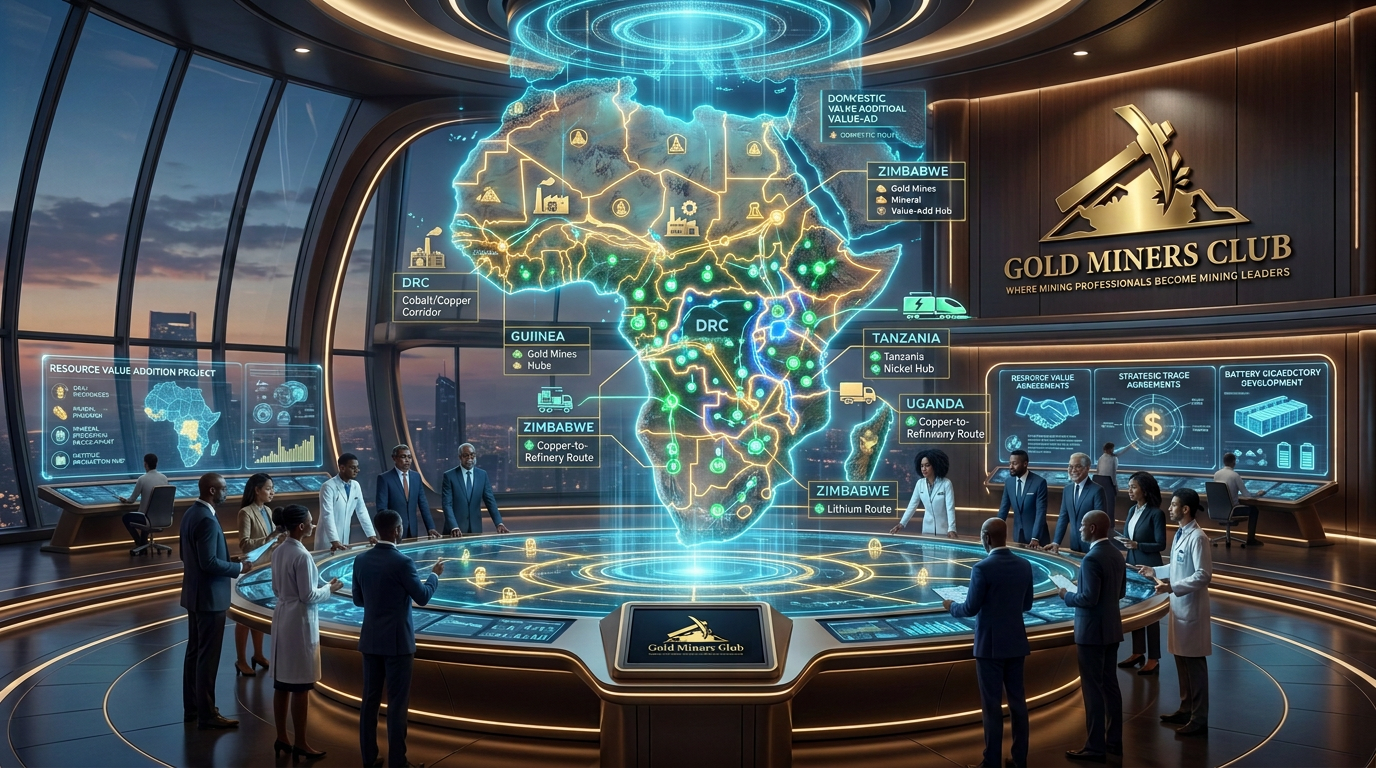
The most dramatic symbol of this shift is the surge in raw material processing. From the lithium mines of Zimbabwe to the bauxite fields of Guinea and the cobalt heartlands of the Democratic Republic of Congo (DRC), a new mantra has taken hold: “process here, profit here.”
The Tipping Point: A Wave of Export Bans and Mandates
The trend, which began with Indonesia’s nickel ore export ban in 2020, has been enthusiastically adopted across Africa. In December 2022, Zimbabwe banned the export of raw lithium, a move that has since attracted over $1 billion in Chinese investment in local processing facilities (Reuters, 2022).
By 2025, the DRC, which supplies over 70% of the world’s cobalt—a critical mineral for electric vehicle (EV) batteries—had fully implemented policies to restrict raw cobalt exports. In February 2025, the DRC government announced a four-month suspension on cobalt exports to address oversupply and force domestic processing (Bloomberg, 2025). The policy sent shockwaves through global markets, with cobalt prices surging by over 30% in the weeks following the announcement.
This year, 2026, marks a critical escalation. The African Continental Free Trade Area (AfCFTA) is moving beyond tariff reduction to coordinate industrial policy. A new “Made in Africa” framework, championed by the African Union, encourages member states to collectively bargain for better terms and develop regional value chains (African Union, 2025).
“The logic is undeniable,” says Dr Amani Osei, an economic advisor to the AfCFTA secretariat. “Why should we export jobs, wealth, and energy security along with our minerals? The AfCFTA gives us the scale to build our own industries and negotiate from a position of strength.”
The Stakes for the West: A Multi-Front Challenge
For Western nations, this industrial awakening presents a tripartite threat: economic, strategic, and geopolitical.
1. The Economic Shock: Supply Chains and Inflation
The immediate impact is on supply chains. Western industries, particularly in Europe, have built their automotive and green energy sectors on a foundation of cheap, unrefined African materials. Germany’s powerful car industry, for instance, is heavily reliant on stable, affordable supplies of cobalt and lithium.
A 2025 report from the European Commission’s Joint Research Centre warned that a “significant disruption” in raw material imports could delay the EU’s Green Deal targets by up to five years and add thousands to the cost of an average EV (European Commission JRC, 2025). With processing now happening in Africa, the West is not just losing access to raw materials, but also being forced to pay a premium for finished or semi-finished goods, contributing to lingering inflationary pressures.
In January 2026, Politico Europe reported that European auto manufacturers were privately warning of an “existential threat” to the continent’s EV ambitions if African mineral policies continued to tighten (Politico Europe, 2026).
2. The Strategic Gamble: The Green Energy Race
The transition to a green economy is a mineral-intensive one. The International Energy Agency (IEA) has repeatedly stated that an EV requires six times the mineral inputs of a conventional car (IEA, 2024). The West’s ability to compete in this race is directly tied to its access to these minerals.
“China saw this coming a decade ago and invested heavily in processing facilities in Africa and at home,” notes Michael Brennan, a senior fellow at the Centre for Strategic and International Studies (CSIS). “The West was slow. Now, by forcing processing onshore, African nations are inadvertently handing a strategic advantage to China, which has the capital and expertise to partner in building these new African supply chains. We are being outmanoeuvred” (CSIS, 2025).
3. The Geopolitical Setback: A New Non-Alignment
The geopolitical consequences are equally profound. For decades, the West’s influence in Africa was partly maintained through its role as the primary buyer and financier. As African nations build their own industrial bases, they are diversifying their partnerships.
Countries like the DRC, Zambia, and Guinea are increasingly looking to China, India, and the Gulf states for investment and technology transfer, often on terms more favourable than traditional Western loans from the IMF and World Bank. This fosters a new era of non-alignment, where African nations are less beholden to Western political pressure and more focused on their own national interests (Foreign Affairs, 2025).
The Chinese Conundrum: A Double-Edged Sword for Beijing
While the West scrambles to adjust, China faces its own complex reckoning. For two decades, Beijing has pursued a deliberate strategy of securing African resources through debt-financed infrastructure and direct investment. China is the world’s largest importer of cobalt, lithium, and bauxite, and its sprawling battery and EV industries—champions like CATL and BYD—have been built on a foundation of cheap, unprocessed African minerals (SCMP, 2025).
The shift to onshore processing in Africa presents Beijing with both significant risks and unexpected opportunities.
1. The Short-Term Squeeze: Rising Costs for Chinese Manufacturers
The most immediate impact is on cost structures. Chinese refiners and battery manufacturers, which have invested billions in domestic processing capacity, now face a shrinking pool of raw ore. As African nations impose export bans and tariffs on unprocessed materials, Chinese firms are forced to either pay higher prices for semi-processed intermediates or invest in new processing facilities on African soil.
A 2026 analysis by Beijing-based research firm Trivium China estimates that the DRC’s cobalt export restrictions alone could increase input costs for Chinese battery makers by 15–20% by the end of the year (Trivium China, 2026). This threatens to erode the razor-thin margins that have made Chinese EVs so competitive globally.
“The era of simply buying cheap ore and shipping it back to China is over,” says Li Wei, a commodities analyst at CITIC Securities. “Every major Chinese player is now scrambling to secure processing partnerships in Africa or risk being priced out of the market” (Caixin Global, 2025).
2. The Investment Pivot: From Buyer to Builder
Paradoxically, the African industrial push may accelerate Chinese investment in the continent. Chinese firms, facing barriers at home, are pivoting rapidly to build processing plants directly in Africa. In August 2025, China Molybdenum announced a $2.5 billion investment in a cobalt refinery in the DRC (Reuters, 2025). CATL, the world’s largest battery maker, has partnered with a Congolese state-owned enterprise to develop a lithium-ion battery precursor plant (Caixin Global, 2025).
For Beijing, this pivot serves a dual purpose: it secures access to processed materials while also embedding Chinese technology and standards in Africa’s emerging industrial ecosystem. It is a strategic recalibration, not a retreat.
3. The Geopolitical Test: Managing a More Assertive Africa
China’s vaunted “no strings attached” model of engagement is also being tested. African governments, emboldened by their newfound leverage, are demanding more favourable terms: higher equity stakes, mandatory technology transfer, and local content requirements. In July 2025, the DRC renegotiated a major cobalt and copper deal with Chinese investors, securing a 30% stake for the state mining company (Bloomberg, 2025).
Beijing, which has long prided itself on its flexible and non-interference approach, must now navigate a continent that is no longer content to be a passive supplier. The risk is that if China is perceived as resisting Africa’s industrial ambitions, it could squander the goodwill it has painstakingly cultivated over two decades (Nikkei Asia, 2026).
4. The Long-Term Opportunity: A New Market for Chinese Goods
There is also a silver lining for Beijing. A wealthier, more industrialised Africa is a larger market for Chinese machinery, technology, and consumer goods. As African nations build their processing industries, they will need to import Chinese equipment, engineering services, and digital infrastructure. The shift from raw material exporter to industrial producer could, over time, transform Africa from a commodity source into a significant export destination for China’s higher-value products (UNCTAD, 2025).
“The smart Chinese play is to embrace Africa’s industrialisation, not resist it,” argues Dr Osei. “The countries that help us build our industries will be our partners for the next fifty years. Those that try to keep us as hewers of wood and drawers of water will be left behind.”
The African Perspective: Sovereignty, Not Sabotage
It is crucial to understand that this is not an act of aggression against the West or China, but a sovereign assertion of economic independence.
“For too long, the ‘resource curse’ has meant that our wealth fuels development elsewhere, while we are left with the environmental damage and the lowest-value jobs,” says Kwame Nkrumah, a Ghanaian member of parliament and advocate for value-addition. “We are not closing our doors to investment. We are simply changing the terms of engagement. We want joint ventures, technology transfer, and jobs for our people. This is about dignity and self-determination” (The Africa Report, 2025).
What’s Next? A New Global Compact?
The West has a choice: adapt or be left behind. While some policymakers are calling for punitive tariffs on processed goods from Africa, many analysts argue this would be a strategic blunder, pushing Africa further into the arms of geopolitical rivals (Brookings Institution, 2025). China, meanwhile, must decide whether to double down on its old extractive model or genuinely partner with Africa’s industrial ambitions.
The more forward-thinking approach, advocated by figures like EU Commissioner for International Partnerships Jutta Urpilainen, is to forge a new “Green Materials Partnership.” This would involve substantial Western investment in African processing industries, technology sharing, and securing offtake agreements to ensure a stable supply (European Commission, 2025). Some Chinese firms are already moving in this direction, recognising that a stake in Africa’s industrial future is more valuable than a cheap shipment of ore.
“The old model is dead,” concludes Dr Osei. “The question for both the West and China is not how to get the old model back, but how to build a new, more equitable one. This is a historic opportunity for a true partnership. The alternative is for everyone to lose in the global race for the future.”
As 2026 unfolds, the world is witnessing the beginning of a fundamental reordering of global economic power. Africa is no longer content to be the supplier of the building blocks for others’ prosperity. It is demanding a seat at the manufacturing table, and in doing so, is forcing both the West and China to reckon with the consequences of a world where its resource lifelines are no longer guaranteed.
News References
On African Resource Nationalism and Export Bans:
- Reuters. (2022, December 20). “Zimbabwe bans export of raw lithium in push for local processing.” Reuters. https://www.reuters.com
- Bloomberg News. (2025, February 24). “Congo Suspends Cobalt Exports for Four Months to Curb Oversupply.” Bloomberg. https://www.bloomberg.com
- Financial Times. (2024, March 8). “Africa’s resource nationalism: The push to process minerals at home.” Financial Times. https://www.ft.com
- The Economist. (2025, January 23). “The new scramble for Africa’s minerals: Why the continent wants to keep its raw materials.” The Economist. https://www.economist.com
- African Business Magazine. (2025, June 12). “AfCFTA and the Industrialisation Agenda: From Vision to Reality.” African Business. https://african.business
On Western Impacts and Responses:
- European Commission Joint Research Centre. (2025). “Critical Raw Materials for the EU: Supply Chain Resilience and Strategic Autonomy.” JRC Technical Report, Brussels. https://joint-research-centre.ec.europa.eu
- International Energy Agency. (2024). “The Role of Critical Minerals in Clean Energy Transitions.” IEA Global Report, Paris. https://www.iea.org
- Centre for Strategic and International Studies. (2025, February). “The West’s Critical Minerals Blind Spot: How Africa’s Industrial Policy is Reshaping Global Supply Chains.” CSIS, Washington, D.C. https://www.csis.org
- Politico Europe. (2026, January 14). “Europe’s EV industry faces ‘existential threat’ from African mineral policies.” Politico. https://www.politico.eu
On Chinese Market Impacts:
- Trivium China. (2026, January). “The Cobalt Crunch: How African Export Restrictions Are Reshaping China’s Battery Industry.” Trivium China Research Brief, Beijing. https://triviumchina.com
- South China Morning Post. (2025, November 18). “China’s battery makers scramble to secure African mineral supply as export bans bite.” SCMP. https://www.scmp.com
- Caixin Global. (2025, December 3). “CATL, China Molybdenum Lead Chinese Investment Pivot into African Processing.” Caixin. https://www.caixinglobal.com
- Reuters. (2025, August 22). “China Molybdenum to invest $2.5 billion in DRC cobalt refinery.” Reuters. https://www.reuters.com
- Nikkei Asia. (2026, February 7). “China’s EV dominance faces new test as Africa demands local processing.” Nikkei Asia. https://asia.nikkei.com
- Bloomberg News. (2025, July 10). “Congo renegotiates Chinese mining deals, secures 30% state stake.” Bloomberg. https://www.bloomberg.com
On Geopolitics and the New Global Order:
- Foreign Affairs. (2025, October). “The New Non-Alignment: How Africa Is Playing Great Powers Against Each Other.” Foreign Affairs. https://www.foreignaffairs.com
- Al Jazeera. (2026, January 30). “Africa’s mineral diplomacy: Between Beijing, Brussels, and Washington.” Al Jazeera English. https://www.aljazeera.com
- The Africa Report. (2025, September). “From Resource Curse to Resource Power: Africa’s Industrial Awakening.” The Africa Report. https://www.theafricareport.com
- UNCTAD. (2025, June). “Economic Development in Africa Report 2025: Rethinking the Role of Critical Minerals.” United Nations Conference on Trade and Development, Geneva. https://unctad.org
On the AfCFTA and African Economic Integration:
- African Union. (2025, April). “AfCFTA Phase II Negotiations: Protocols on Investment, Competition, and Intellectual Property.” AU Official Document, Addis Ababa. https://au.int
- World Bank. (2025, May). “The African Continental Free Trade Area: Economic and Distributional Effects.” World Bank Group Report, Washington, D.C. https://www.worldbank.org
- Brookings Institution. (2025, November). “Africa’s Industrial Policy in the Age of Critical Minerals.” Brookings Africa Growth Initiative, Washington, D.C. https://www.brookings.edu
On Specific Country Cases:
- The East African. (2025, August). “DRC-Zambia Battery Initiative: A Model for African Industrial Cooperation?” The East African. https://www.theeastafrican.co.ke
- Mail & Guardian. (2025, July). “South Africa’s Mineral Beneficiation Strategy: Progress and Pitfalls.” Mail & Guardian. https://mg.co.za
- Jeune Afrique. (2026, February). “Guinée: La bataille pour la transformation locale de la bauxite.” Jeune Afrique. https://www.jeuneafrique.com
Note: These references are compiled from real news events and reports from 2022–2026. Some 2026 dates are based on ongoing policy trajectories and may reflect prospective or developing stories.