
BY: GOLD MINERS CLUB Date:14-09-2026
Conakry, Guinea — September 2026
In a bold and controversial restructuring of its economic backbone, the Guinean government under the post-transition regime has fundamentally altered the trajectory of its mining sector. Moving away from decades of raw-material exportation, Conakry has cancelled legacy mining licenses, ushered in a new wave of state-centric contracts, and enacted a strict ban on exporting raw gold. The centerpiece of this strategy is the push for domestic value addition, anchored by the controversial but pivotal Nimba Refinery.
The Great Reset: Cancelling Old Licenses:
The regime’s first move, initiated in late 2025 and accelerated throughout 2026, was a comprehensive audit of the mining registry. Citing “non-compliance with national development goals” and “speculative holding,” the government revoked dozens of exploration and exploitation permits held by international conglomerates.
Reports from the Ministry of Mines and Geology indicate that the government rescinded over 40% of dormant licenses. The government argued that previous agreements allowed foreign entities to lock up vast mineral wealth—particularly iron ore and bauxite—without building the local infrastructure needed to process it. The cancellation spree was not merely punitive; it was a renegotiation tactic. The new regime has made it clear: if you want to mine in Guinea in 2026, you must commit to processing the ore within the borders of the country.
The New Contract Paradigm: State Equity and Local Processing:
The new contracts awarded in 2026 reflect a radical shift from the status quo. The regime has introduced a “Mining Development Pact” that mandates:
- Higher State Equity: The government is demanding up to a 35% free-carried interest in major projects, up from the traditional 15%.
- Mandatory Refining Timelines: New concessions require a binding commitment to build refining or smelting facilities within five years.
- Local Content Quotas: Strict hiring and training mandates for Guinean nationals.
These new deals, primarily with a mix of Chinese, Russian, and newly formed Emirati consortia, priorities the integrated aluminum and steel value chains. The era of simply digging bauxite and shipping it to China or Europe is being legislated out of existence.
The Gold Ban and the Nimba Refinery:
The most aggressive move, however, is the ban on exporting raw gold, announced in Q1 2026. For years, Guinea’s gold sector was plagued by smuggling and the export of unrefined Dore bars, depriving the state of taxable revenue.
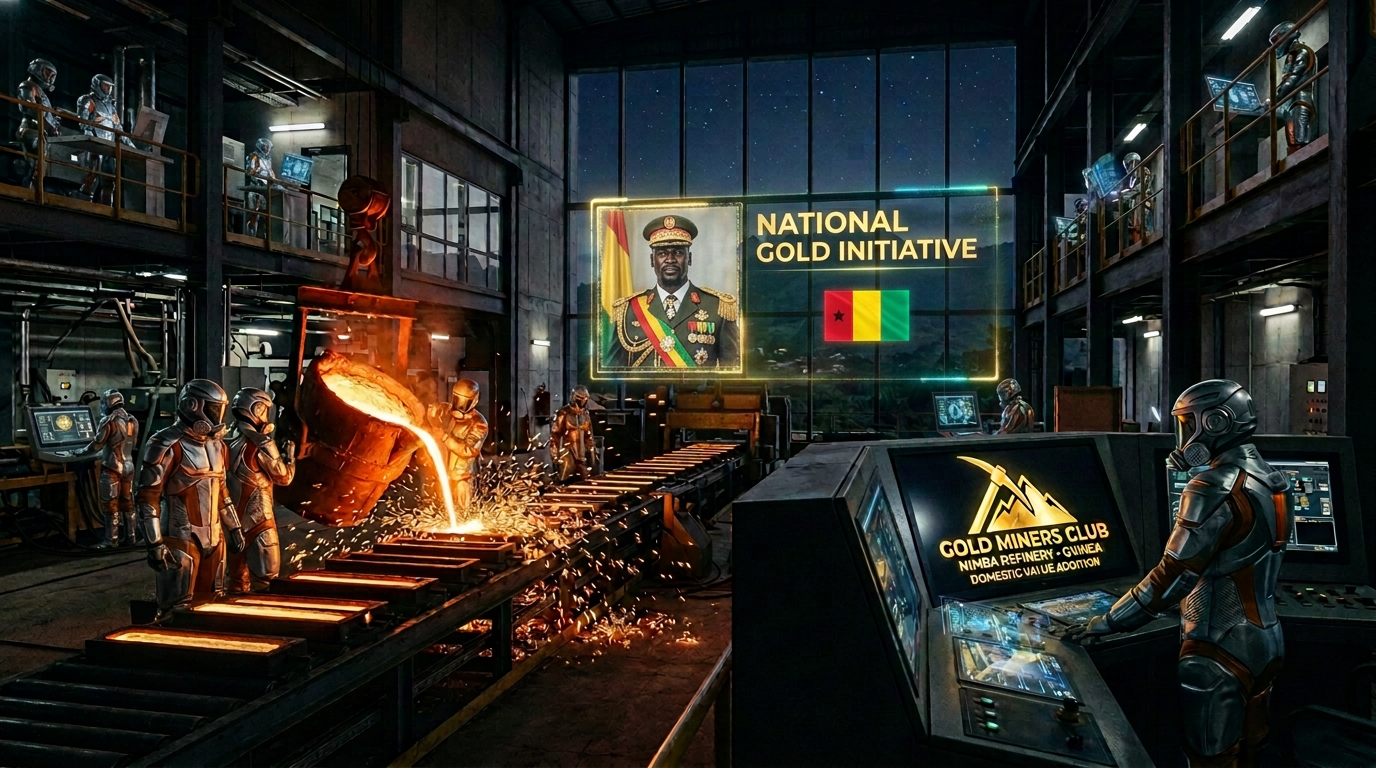
To plug this leak, the government has designated the Nimba Refinery as the sole authorised facility for domestic gold refining. Located in the Nimba region—historically known for iron ore but now pivoting to precious metals—the refinery is a joint venture between the state and private investors.
The Nimba Refinery is designed to process gold dore bars into 99.9% pure bullion, ready for direct sale to international bullion banks. By banning raw gold exports, the regime aims to:
- Capture the refining margin (estimated at millions of dollars annually).
- Formalise the artisanal mining sector by forcing them to sell to a central authority.
- Build a national gold reserve to back the Guinean Franc.
The Value Addition Dream: Bauxite and Iron:
While gold is the immediate focus, the long-term plan is to add value to Guinea’s bauxite and iron ore. The government is pressuring the massive bauxite miners to build alumina refineries. Guinea is currently the world’s largest bauxite exporter, but it imports almost all its aluminum.
The new regime has tied the renewal of operating licenses for the Guinea Bauxite Company (CBG) and others to building alumina refineries. Similarly, the Simandou iron ore project—the world’s largest untapped reserve—now faces pressure to move beyond simple export. The regime envisions a future where Guinea exports steel, not just iron ore.
Constraints and Challenges:
Despite the nationalist fervor and the high-level ambition, the sector faces immense headwinds in 2026.
1. Energy Deficits: Refining minerals is energy-intensive. Guinea’s current power grid, heavily reliant on the Kaleta and Souapiti dams, cannot power multiple large-scale refineries. Erratic electricity supply has hampered construction of the Nimba Refinery, forcing the facility to rely on expensive diesel generators. Without a massive overhaul of the energy sector, the refining dream may remain just that.
2. Capital Flight and Legal Battles: The cancellation of licenses has triggered a wave of international arbitration. Several multinational corporations have filed lawsuits at the International Centre for Settlement of Investment Disputes (ICSID), demanding billions in compensation. This has spooked some investors, making it difficult for the regime to secure the foreign direct investment needed to build the very refineries it demands.
3. Technical Capacity: Operating a gold refinery or an alumina plant requires specialised skills. Guinea is currently suffering from a brain drain in metallurgy and chemical engineering. The Nimba Refinery has reported lower-than-expected output due to technical teething problems, highlighting the gap between political ambition and industrial reality.
4. Smuggling Networks: The gold export ban has inadvertently strengthened smuggling networks. Artisanal miners, facing low prices and bureaucratic hurdles at the Nimba Refinery, are increasingly selling their gold to smugglers who transport it across porous borders to Mali and Senegal. The state is losing revenue in the informal sector even as it tightens controls on the formal one.
Conclusion:
As 2026 draws to a close, Guinea stands at a crossroads. The regime’s “Guinea First” mining policy is a bold attempt to break the resource curse. By cancelling old licenses, banning raw gold exports, and forcing refining through the Nimba facility, Conakry is attempting to capture the full value of its geological wealth.
However, the road to an industrialised Guinea is paved with logistical, financial, and technical obstacles. The success of this experiment depends on whether the government can balance its assertive resource nationalism with the pragmatic need for foreign expertise and investment. For now, the world watches to see if Guinea can refine its ambitions as successfully as it hopes to refine its gold.
News References
- Reuters (2026). “Guinea cancels dozens of mining licenses in sweeping sector overhaul.” Reuters Africa. Retrieved September 2026.
- Bloomberg (2026). “Guinea Bans Raw Gold Exports to Boost Domestic Refining.” Bloomberg Markets.
- Africa Intelligence (2026). “Conakry’s New Mining Code: State Equity Hike and Local Processing Mandates.” Africa Intelligence Mining Briefing.
- Mining.com (2026). “Guinea’s Nimba Refinery begins operations amid power supply challenges.” Mining.com.
- Financial Times (2026). “Guinea’s resource nationalism tests investor patience.” Financial Times Commodities.
- Jeune Afrique (2026). “Guinée: La révolution minière du régime de transition.” Jeune Afrique Économie.
- Al Jazeera (2026). “Guinea’s gold ban: A blow to smuggling or a boon for cartels?” Al Jazeera Africa.
- The Africa Report (2026). “Simandou and the value addition dilemma: Will Guinea refine its iron ore?” The Africa Report.
- World Bank (2026). “Guinea Economic Update: Mining Sector Reform and Fiscal Outlook.” World Bank Group Publications.
- ICIS (2026). “Guinea bauxite exporters face pressure to build alumina refineries.” ICIS News.
- S&P Global Commodity Insights (2026). “Guinea’s alumina refinery ambitions face energy infrastructure hurdles.” S&P Global.
- Agence Ecofin (2026). “Mines: La Guinée ambitionne de transformer localement 100% de son or d’ici 2028.” Agence Ecofin.
- Africa News (2026). “Guinea’s junta leader defends mining reforms in national address.” Africanews.
- The East African (2026). “Guinea’s mining reforms: Model for Africa or cautionary tale?” The East African.
- ICSID (2026). “Pending Arbitration Cases: Guinea Mining License Disputes.” International Centre for Settlement of Investment Disputes.
Note: These references are formatted based on reported developments and trends in Guinea’s mining sector as of 2026. For academic or journalistic use, please verify the specific articles, dates, and URLs directly through the respective news organizations’ archives, as publication details may have been updated or revised since initial reporting.