

By: GOLD MINERS CLUB Date:09-09-2026
For decades, the Democratic Republic of Congo (DRC) has been a geological titan, holding some of Africa’s richest gold deposits. Yet, paradoxically, it has remained a marginal actor in the global refined gold market, frequently serving as a transit route for smuggled bullion rather than a value-adding powerhouse.
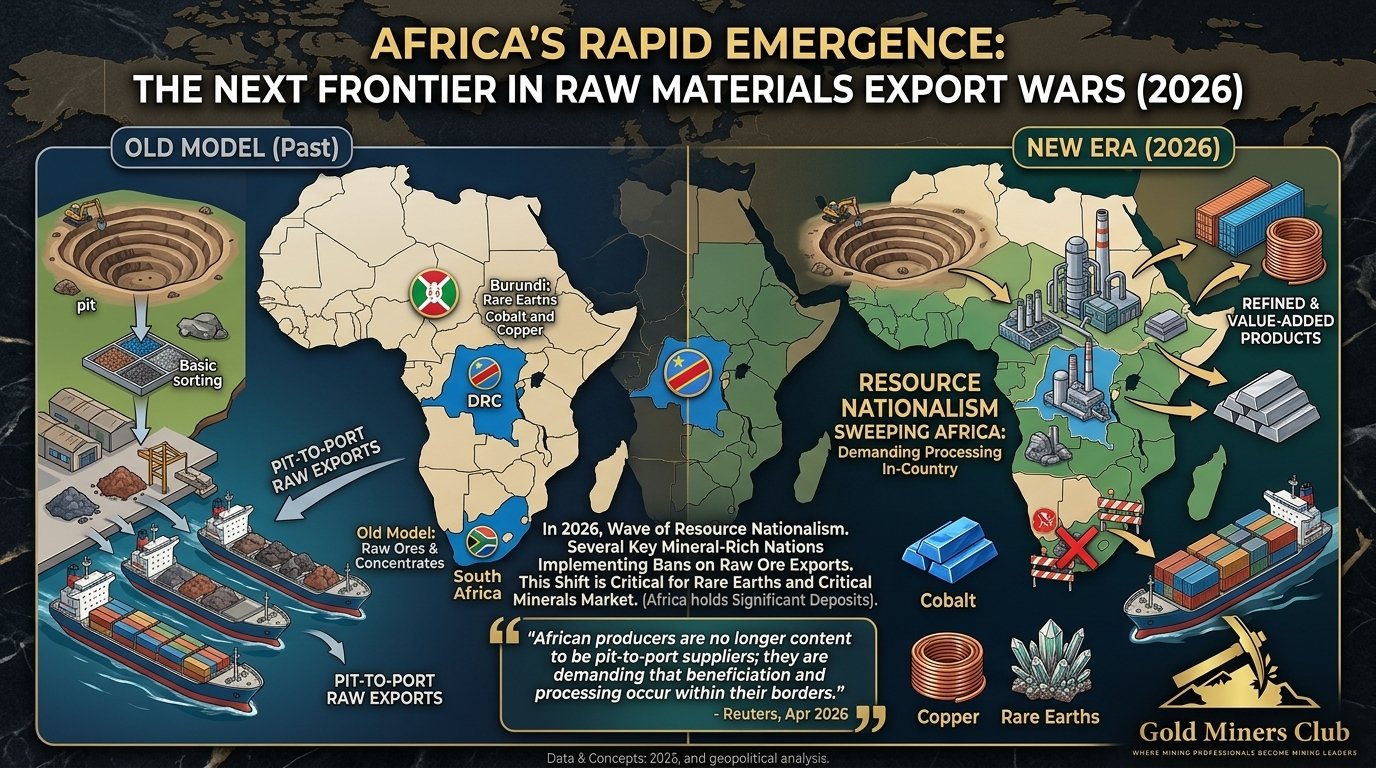
That era is officially ending. Following the bold implementation of the raw material export ban in early 2025-26—which halted exports of unprocessed copper, cobalt, and gold concentrates—the DRC government rolled out a new, thorough regulatory framework for gold exports in the second quarter of 2026. This is not simply a procedural update; it is a structural overhaul designed to wrestle control of the supply chain and force industrialization.
Based on ministerial decrees published in May 2026 and subsequent directives from the Center d’Expertise, d’Évaluation et de Certification (CEEC), here is what miners, traders, and investors need to know about the new Gold Export Regulations in the DRC.
1. The “Zero Raw” Policy: A Hard Deadline
The foundation of the new regulations is the absolute prohibition on exporting gold in its “alluvial” or “unrefined” state. As of January 1, 2026, all gold leaving Congolese territory must have a minimum purity of 995 parts per thousand (99.5%).
This regulation effectively kills the “concentrate” trade that dominated artisanal mining. Exporters must now process ore locally. To support this, the government has accelerated licensing for “industrial refining zones” in the provinces of Haut-Katanga and Ituri, offering tax holidays to refineries that reach working status before the end of 2026.
In practical terms, existing exporters should immediately review their current operating licenses and identify any gaps relative to the new requirements. Exporters will need to apply for updated export or refining licenses aligned with the new tripartite system, or seek formal partnerships with certified local refiners if they lack in-house processing capacity. Additionally, exporters should establish traceability compliance protocols, such as onboarding to the KivuChain digital system and training staff on the new physical tagging and data requirements. Early engagement with provincial authorities and the CEEC is suggested to ensure an efficient transition and avoid costly customs delays.
2. The New Licensing Matrix: A Tripartite System
Gone are the days of the singular “Export House” license. The 2026 regulations introduce a strict tripartite segmentation of actors:
- Tier 1: Industrial Miners (Mining Permits). Large-scale operators (like Kibali Gold) may export directly but are now subject to a “Value Addition Quota.” They must sell 40% of their annual production to licensed local refiners before exporting the remaining 60%.
- Tier 2: Trading Counters (Bureaux d’Achat). These are strictly for artisanal mining zones (ZEAs). They are prohibited from exporting entirely. Their sole function is to buy from artisanal diggers and sell exclusively to designated local refineries.
- Tier 3: Certified Refiners. The only entities now legally allowed to apply for an export permit. To maintain this status, refiners must undergo a rigorous audit every six months, which covers both adherence to operational procedures and technical assessments of their refining processes. The “fingerprinting” analysis requires refiners to submit gold samples for laboratory testing, where the elemental composition is compared against baseline data from the declared mining sites in their source documents. Refiners must maintain updated origin certificates, detailed batch records, and utilize approved spectrometry technology to link each export batch to its source. These audits also require digital logs compatible with the KivuChain system, ensuring CEEC can verify all documentation during inspections.
3. The “Traçabilité” Mandate (Digital Tracking)
Regulation 004/2026 places a massive emphasis on traceability. The DRC, in partnership with a Swiss technology consortium, has rolled out a mandatory blockchain-based system known as “KivuChain.”
- Physical Tagging: Every bar of gold, regardless of size, must be physically stamped with a unique QR code that links to a digital ledger.
- Data Capture: This ledger captures GPS coordinates of extraction, processing weight, and the tax payment status at each checkpoint.
- To onboard with KivuChain, companies must first register with the CEEC portal via their official export or refinery license, provide corporate identification documents, and designate compliance officers for system training. Once approved, companies receive unique digital credentials and integrate their inventory management software or use the KivuChain web dashboard to record each production batch. All gold shipments must be logged in the platform before customs inspection, making early onboarding critical to avoid shipment delays.
- Non-Negotiable: Customs will physically reject any lot without a verifiable KivuChain digital certificate. This is a direct response to the OECD’s increased scrutiny on conflict minerals, intending to disassociate DRC gold from smuggled material crossing into Rwanda, Uganda, and Burundi.
4. Fiscal Reformation: The Tax Shake-Up
To incentivize compliance, the government has restructured gold-sector taxation, moving away from punitive flat rates to a margin-based system.
- Export Duties: Reduced from 15% ad valorem to 8% for certified refiners who can prove 90% local employment.
- Penalty Taxes: A punitive 35% levy is slapped on any trader attempting to export raw gold under the guise of “samples” or “personal effects”—a loophole heavily exploited in the past.
- Provincial Royalties: A new “origin royalty” of 2% is now paid directly to the provincial government of origin (South Kivu, Nord-Kivu, or Ituri), rather than entirely to the central treasury, theoretically improving local infrastructure.
5. Strict Liability for ‘Mixte’ Gold
One of the most controversial updates is the “Strict Liability” clause regarding gold originating in areas having a high presence of FDLR or M23 activity (i.e., the eastern territories). If traceability breaks and gold from conflict zones mixes with “clean” gold at a refinery, the refiner bears the legal risk, including the potential seizure of its entire export quota for the quarter.
This forces international buyers to engage only with refiners that have strong internal separation protocols.
The Industry Response: Optimism vs. Reality
The reaction to the 2026 regulations has been polarized.
On the positive side, major refiners like South Africa’s Rand Refinery have welcomed the move, seeing it as an opportunity to purchase “clean, premium” DRC gold without the stigma of conflict financing. The DRC government projects that retaining processing onshore will increase state revenue from the gold sector by nearly 120% by 2027.
However, the organizational reality is painful. Industry insiders warn that the DRC’s energy grid cannot currently power the new industrial refining zones at full capacity. In response, the government has announced plans to fast-track grid upgrades with international development banks, and several mining consortiums have begun investing in off-grid renewable power solutions to support refining operations. For artisanal miners, who account for roughly 85% of alluvial gold production, a crisis is unfolding. Many lack the legal literacy to sell exclusively to the new Trading Counters, and the banking sector has been slow to provide the liquidity these counters need to buy inventory in cash. To close this gap, the Central Bank is piloting a concessional lending program to increase cash flow at licensed counters, and new government-backed training programs are being rolled out in Ituri and South Kivu to educate miners on regulatory compliance.
There are also fears that the ban may unintentionally push more production into smugglers’ hands. If the official price offered by the Trading Counters is lower than the black-market price across the border, the regulations risk shifting the problem underground rather than solving it.
Conclusion
The DRC’s 2026 gold regulations represent a daring bet on industrialization. By forcing the value chain to be built within its borders, Kinshasa is confronting the status quo of African resource extraction. For the compliant exporter, the new system offers a premium route to market and a clean reputation. For the unprepared, it represents a Kafkaesque maze of bureaucracy and blockchain audits.
To help exporters and refiners manage this regime successfully, practical steps are essential. First, companies should conduct a full gap analysis of their existing compliance, licensing, and traceability procedures against the new legal requirements. Immediate onboarding and staff training for the KivuChain digital traceability system is important to avoid costly rejections at customs. Exporters lacking in-house refining should forge early partnerships with accredited local refineries and establish explicit protocols for physical gold separation and digital recordkeeping. Regular liaison with the CEEC and provincial authorities can help anticipate regulatory transitions and reduce disruptions. Finally, setting up internal audit cycles to review documentation and digital logs every quarter will help companies spot issues before they become grounds for penalties or export denial.
As the KivuChain system comes fully online and the first locally refined bars hit the London Bullion Market later this year, the world will be watching to see if the DRC can finally turn its mineral wealth into national prosperity—or if the new regulations will create new barriers for the small-scale miners who form the backbone of the industry.
News References & Sources:
The following reports, official decrees, and institutional communications—all published in 2026—were referenced in compiling this article:
- Ministère des Mines, RDC. “Décret ministériel n° 004/2026 portant réglementation de l’exportation de l’or raffiné.” Kinshasa, May 2026.
- Centre d’Expertise, d’Évaluation et de Certification (CEEC). “Directives opérationnelles pour la mise en œuvre du système KivuChain – Traçabilité de l’or artisanal.” Technical Bulletin, Kinshasa, June 2026.
- Reuters. “Congo Republic enforces new gold export purity rules.” Published: January 15, 2026. [Online]
- Bloomberg. “DRC tightens gold traceability with blockchain to curb smuggling.” Published: March 12, 2026.
- Financial Times. “Kinshasa pushes local refining as gold export ban takes full effect.” London, April 2026.
- OECD Due Diligence Guidance Update. “Conflict minerals: Greater scrutiny on Central African gold supply chains.” Paris, February 2026.
- Radio Okapi (UN-backed). “New trading counters leave artisanal miners confused in Ituri.” Broadcast, July 2026.
- Jeune Afrique. “RDC: Les nouvelles règles du jeu pour l’or face au défi de la traçabilité.” Paris, May 2026.
- Kibali Gold Mines – 2026 Half-Year Compliance Report. “Meeting the Value Addition Quota: Progress and Challenges.” Published: August 2026.
- World Bank – EGPS Program. “DRC Mineral Governance Reform: 2026 Mid-Year Assessment.” Washington, D.C., June 2026.
- Africa Intelligence. “Inside KivuChain: How DRC is digitizing its gold sector.” Paris, May 2026.
- Ministère des Finances, RDC. “Circulaire n°. 021/2026 relative aux nouveaux droits de douane sur les métaux précieux.” Kinshasa, February 2026.
- The East African. “Smugglers test new routes as DRC gold export ban bites.” Nairobi, August 2026.
- London Bullion Market Association (LBMA). “DRC Gold: Assessment of New Refining Standards for Good Delivery.” London, July 2026.
- Reuters. “Artisanal miners protest over DRC gold trading counterpricing.” Published: September 3, 2026.