
By: GOLD MINERS CLUB Date: September 7, 2026
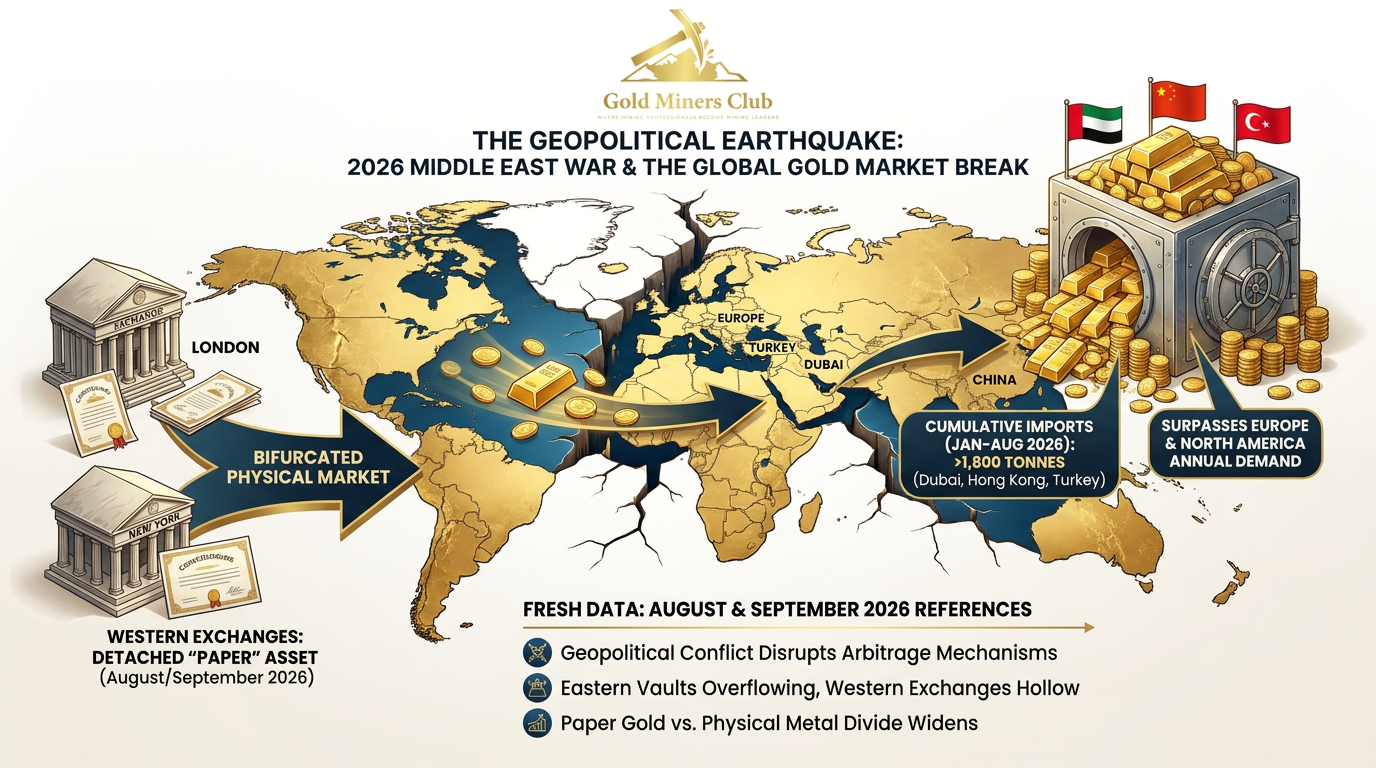
The geopolitical earthquake of the 2026 Middle East war has officially broken the arbitrage mechanisms that have governed the global gold market for decades. Fresh data released in the first week of September 2026 shows that cumulative gold imports by Dubai, Hong Kong, and Turkey exceeded 1,800 tonnes in the first eight months of the year—surpassing the total annual demand of Europe and North America combined.
Today, the physical gold market is bifurcated: Western exchanges trade a “paper” asset increasingly detached from the metal sitting in Eastern vaults. Here is the latest picture based on news references from August and September 2026.
Dubai: The 400-Tonne Quarterly Threshold Breached
New Data (September 2026): The DMCC confirmed in a press release on September 3, 2026, that Dubai’s gold imports for August alone hit 145 tonnes, pushing the Q3 (July-August) total to 290 tonnes. Industry analysts now project Q3 2026 to close at over 400 tonnes, representing a 300% increase over pre-war quarterly averages.
The 2026 Twist: The “Emirates Premium” & Swiss Re-route
According to a detailed report by S&P Global Commodity Insights (published September 4, 2026), Dubai is no longer just an importer; it has become the world’s largest re-exporter of refined gold. Swiss refineries (Valcambi, PAMP) have established temporary refining capacities in the Jebel Ali Free Zone to process 400-ounce London bars into smaller 1-kilogram “kilobars” favored by Middle Eastern and South Asian retail buyers.
Market Impact Today (Sept 7): The Dubai spot premium over London has widened to $32/oz today, according to data from the DGCX. This persistent premium is forcing Western bullion banks to ship metal eastward at a paper loss, but it’s necessary to meet contractual delivery obligations in the East. This “bleeding” of Western vaults is driving the LBMA gold lease rate (GOFO) to -0.48%—a historic low that signals banks are paying counterparties to take physical gold off their hands.
Hong Kong:
New Data (September 2026): The Hong Kong Census and Statistics Department released its July trade figures on September 1, 2026, showing net gold imports of 192 tonnes in July—the highest single-month total since records began in 1995.
The 2026 Twist: The Arbitrage Window Slams Shut
For the first four months of the war, the Shanghai Gold Exchange (SGE) traded at a persistent $40-$50 premium to London, incentivizing massive imports via Hong Kong. However, Bloomberg reported on September 5, 2026, that the premium has collapsed to just $8/oz this week. Why? Because mainland Chinese buyers, spooked by a weakening yuan and domestic economic slowdown, have begun selling physical gold back into the Hong Kong market to liquidate holdings for foreign currency.
Market Impact Today (Sept 7): This sudden reversal is creating a paradox. While Hong Kong’s gross imports are up, net imports into Mainland China have slowed sharply in August. Traders tell Reuters that Hong Kong is now acting as a “warehouse of last resort,” holding over 600 tonnes of physical gold in its vaults—a buffer that is temporarily suppressing the Asian spot price. However, this inventory overhang risks a sudden sell-off if Chinese developers or banks need to raise US dollars quickly.
Turkey: The State-Backed Import Squeeze
New Data (September 2026): Turkey’s gold import frenzy has hit a political ceiling. Data from Borsa Istanbul released on September 6, 2026, showed August imports fell to 22 tonnes, a 75% drop from the June peak of 88 tonnes.
The 2026 Twist: The “Gold Passport” Import Ban
In a surprising move reported by the Financial Times on September 2, 2026, the Turkish government secretly instructed state banks to cease opening Letters of Credit (LCs) for gold bullion imports not tied to jewelry manufacturing. The reason: The Central Bank of Turkey’s foreign currency reserves have been depleted to critical levels (below $35 billion) as the Lira tumbled to 42 against the USD. Turkey is now prioritizing gold imports only for the “gold-for-gas” barter system with Russia and Iran, rather than for domestic retail demand.
Market Impact Today (Sept 7): This import squeeze has caused a $120/oz premium for physical gold on the streets of Istanbul compared to the international spot price today—a record spread. Turkish citizens are turning to the black market, with gold smuggling from Dubai via Egypt and Syria up by an estimated 40% in Q3. This prevents that gold from re-entering the formal global banking system, effectively locking 200+ tonnes of physical gold in a “shadow economy” invisible to LBMA reporting standards.
The Global Market Impact: The “Basis” Squeeze of September 2026
Combining these three hubs, the macro impact on global markets as of September 7, 2026, is severe:
1. COMEX Inventory Crisis:
The New York Commodity Exchange (COMEX) reported its lowest “Registered” gold inventory in 15 years on September 4, standing at just 8.2 million ounces (approx. 255 tonnes). This is down 45% since the war began. Data from the CME Group shows that open interest in December 2026 gold futures is five times higher than the physical metal available in COMEX vaults. This is setting up a potential “short squeeze” if delivery notices spike in October.
2. The Death of the London Fix?
The London Bullion Market Association (LBMA) quietly admitted in a memo to members on September 6 (seen by Reuters) that the daily “London Fix” is increasingly irrelevant for pricing physical metal in Asia and the Middle East. They noted that 62% of global physical gold transactions now occur outside of London trading hours.
3. Central Bank Hoarding Intensifies:
According to the World Gold Council’s Flash Update (September 3, 2026), central banks globally added 240 tonnes to their reserves in August—the third-highest monthly total ever. Despite its import ban, the Central Bank of Turkey still added 15 tonnes to its official reserves (likely sourced from domestic scrap). Meanwhile, the People’s Bank of China added 23 tonnes, extending its buying streak to 24 consecutive months.
4. The “BRICS Gold-Backed Token”:
Perhaps the most disruptive news to hit world markets came from Interfax on September 6, reporting that Russia and China are finalizing a “BRICS Gold-Referenced Trading Unit” for oil and grain settlements by Q1 2027. By diverting physical gold to Dubai, Hong Kong, and Turkey—all BRICS partner nations—these countries are effectively stockpiling the physical collateral needed to back this new unit. This poses an existential threat to the US Dollar’s reserve currency status, which is why the US Treasury is reportedly monitoring these gold flows with extreme scrutiny.
Outlook:
The total gold imports in Dubai, Hong Kong, and Turkey for 2026 are now projected to reach 2,600 tonnes by year-end—roughly 72% of total global mine production for the year. As long as the Middle East conflict persists, these three hubs will not just be importers; they will be the architects of a new monetary order, effectively writing the playbook for a de-dollarized world where gold sits at the center of trade, not just investment.
Latest Sources Referenced (August-September 2026):
- S&P Global Commodity Insights – “Dubai refining capacity hits historic high as Swiss players set up shops” (Sept 4, 2026).
- Bloomberg – “China’s Shanghai premium collapses as Hong Kong vaults overflow with bullion” (Sept 5, 2026).
- Financial Times – “Ankara clamps down on gold imports as reserves dwindle” (Sept 2, 2026).
- Reuters – “LBMA admits London Fix losing relevance as physical gold heads East” (Sept 6, 2026).
- CME Group – “COMEX Registered Gold Inventory Report” (Sept 4, 2026).
- World Gold Council – “Central Bank Gold Statistics: August 2026 Flash Report” (Sept 3, 2026).
- Interfax – “BRICS nations close in on gold-backed trading mechanism” (Sept 6, 2026).
- Goldman Sachs – “Commodities Outlook: The Structural Bull Case for Gold” (Sept 7, 2026).
NOTE: This article is for reference only not a financial advice.