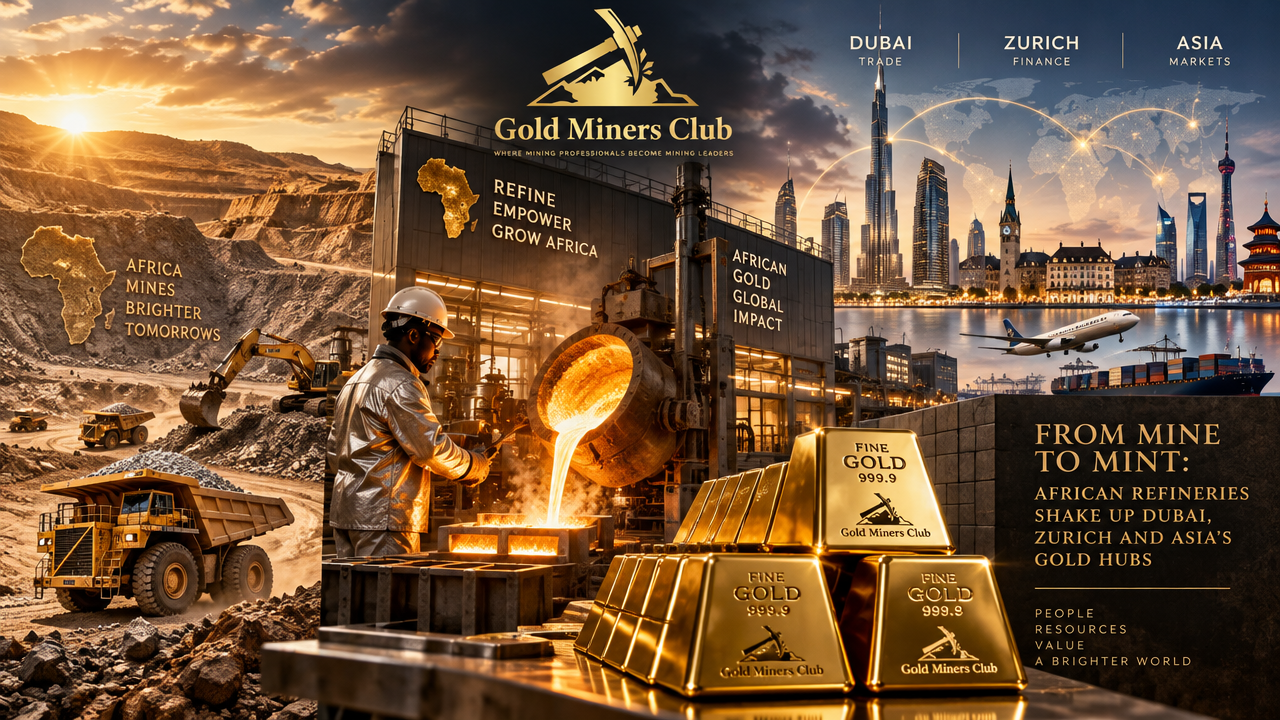


By: GOLD MINERS CLUB DATE: 12-10-2026
For years, Ethiopian gold left the country in rough form and was finished abroad. On 10 October 2026, the government set out to change that. Ethiopia inaugurated a precious metals refinery at the Bole Lemi Special Economic Zone, aiming to expand domestic processing and keep more value from a gold sector that earned a reported $5.5 billion in exports in 2025/26. The plant is the centrepiece of an ambition to move from mining to refining, and from refining to regional leadership. ecofinagency
The facility and its capacity
The refinery is a partnership between state-owned Ethiopian Investment Holdings, which holds 51%, and Sam Precious Metals, which holds 49%. Sam Precious Metals is headquartered in Dubai, with a presence in Cairo. trendsnafricabeninwebtv
The headline figure is capacity. The National Precious Metals Refinery is designed to process more than 600 tonnes of precious metals a year, and will also produce cast and minted gold and silver bars of varying purities. It is designed to test, refine and cast gold into export-ready bullion. eastleighvoiceecofinagency
Three caveats matter when reading that number:
- It is design capacity, not output. The figure describes what the plant can handle at full operation, not volumes refined since launch. beninwebtv
- It covers precious metals generally. The announcement did not say how much of the capacity is for gold specifically. peopledaily
- It far exceeds domestic supply. The IMF projected Ethiopian gold exports at roughly 30 tonnes in 2025/26, so the stated capacity is well above that. One report put capacity at more than 13 times Ethiopia’s yearly gold output, with full utilisation depending on metal from neighbouring countries and mining companies across Africa. trendsnafricamereja
The economic case
The government’s argument is about value capture. Prime Minister Abiy Ahmed said gold exports were worth $5.6 billion last year and that the figure “could have been at least 10 billion” had the capacity existed earlier, and noted that shipped material is at most about 70 percent pure gold. (Reports differ slightly on the 2025/26 export figure, $5.5 billion versus $5.6 billion, depending on the source and rounding.) mereja
Gold now matters enormously to the economy. It accounted for half of Ethiopia’s roughly $11 billion in total export revenue in 2025/26. It has become a key source of hard currency since the government floated the birr in July 2024. ecofinagencyriotimesonline
Refining at home also changes the trade route. The IMF previously identified Dubai as the sole destination for refining and importing Ethiopian gold. The central bank governor has said that once the plant is running, all gold produced in Ethiopia will be refined at home before export. The government also links the plant to the jewellery industry and a more transparent, competitive gold value chain. Ethiopia Opens Precious Metals Refinery To Boost Domestic Gold Processing +2
The regional ambition
Abiy has been explicit that the plant is meant to serve more than Ethiopia. He described it as a step toward positioning the country as a regional hub for precious-metals refining. Beyond domestic producers, the refinery is intended to offer processing, testing and certification services to neighbouring countries and mining companies across Africa. eastleighvoicetrendsnafrica
The government’s most striking claim is that the plant’s capacity makes exports of up to $80 billion a year possible. State media itself qualified this: the figure depends on how much metal the refinery can attract and is potential export capacity, not a guaranteed annual value. merejamereja
The challenges
Feedstock. A 600-tonne plant fed by a 30-tonne domestic industry is a plant that must import material. The announcement gave no details on expected external clients or projected processing volumes. Attracting doré from neighbours means competing on price, speed, logistics and trust. peopledaily
Accreditation. Quality credentials will decide how far the refinery’s bars travel. Only one African refinery, South Africa’s Rand Refinery, currently holds LBMA accreditation. A refinery without accreditation can still produce high-purity gold, but accreditation streamlines commercial transactions. The bar is high: LBMA’s minimum output requirements and responsible-sourcing rules have so far kept other African refineries from gaining accreditation. Whether Bole Lemi pursues LBMA status has not been announced in the coverage I found. News Industry +2
Competition. Others are moving too. Ghana, Africa’s largest gold producer, has commissioned several refineries and aims to secure LBMA accreditation for at least one by 2030. Tanzania is also debating how to build an LBMA-grade facility. ecofinagency
Responsible sourcing. A hub that processes metal from across the continent will be judged on provenance. LBMA-linked systems require responsible sourcing to prevent the processing of conflict gold. Robust traceability and anti-money-laundering controls will be as important as furnace capacity. engineeringnews
What to watch
Several indicators will show whether the hub materialises:
- Actual throughput in the first year, compared with the 600-tonne design figure.
- Whether regional producers sign supply or toll-refining agreements.
- Whether the plant seeks, and wins, international accreditation.
- Whether domestic gold truly shifts from informal and cross-border channels into the formal, refined chain.
Ethiopia has built the capacity first and now has to build the supply, credibility and trade relationships to fill it. If it does, refining could become the most valuable link in its gold chain.
News references
- People Daily, “Ethiopia opens new refinery to expand local gold processing” – https://peopledaily.digital/news/ethiopia-opens-new-refinery-to-expand-local-gold-processing/amp
- Ecofin Agency, “Ethiopia Opens Gold Refinery to Process More Gold Locally” – https://www.ecofinagency.com/news-industry/1010-59634-ethiopia-opens-gold-refinery-to-process-more-gold-locally
- Eastleigh Voice, “Ethiopia launches first gold refinery to boost precious metals exports” – https://eastleighvoice.co.ke/ethiopia/410608/ethiopia-launches-first-gold-refinery-to-boost-precious-metals-exports
- Rio Times, “Ethiopia Opens Gold Refinery With 600-Tonne Capacity” – https://www.riotimesonline.com/ethiopia-opens-gold-refinery-600-tonne-capacity-2026/
- Trends Africa, “Ethiopia Opens Precious Metals Refinery to Boost Domestic Gold Processing” – https://trendsnafrica.com/ethiopia-opens-precious-metals-refinery-to-boost-domestic-gold-processing/
- Mereja (citing BBC Amharic and Fana), “Abiy Ahmed opens a refinery in Addis Ababa built to process 600 tonnes of precious metals a year” – https://mereja.com/index/837522
- Benin Web TV, “Ethiopia: Abiy Ahmed inaugurates precious metals refinery in Bole Lemi” – https://beninwebtv.bj/en/ethiopia-abiy-ahmed-inaugurates-precious-metals-refinery-in-bole-lemi/
- Birr Metrics, “Ethiopia’s First Gold Refinery Targets 600 Tonnes in Annual Capacity” – https://birrmetrics.com/ethiopias-first-gold-refinery-targets-600-tonnes/
- Ecofin Agency, “Why West African gold refineries still depend on a London institution” – https://www.ecofinagency.com/news-industry/0607-57083-why-west-african-gold-refineries-still-depend-on-a-london-institution
- Mining.com, “South Africa’s century-old gold refiner runs at 75% as mines dim” – https://www.mining.com/web/south-africas-century-old-gold-refiner-runs-at-75-as-mines-dim/
- Engineering News, “Refinery looks to rest of Africa for gold volumes” – https://www.engineeringnews.co.za/article/refinery-looks-to-rest-of-africa-for-gold-volumes-2019-06-28
- Daily News (Tanzania), “Strategies for Tanzania to develop an LBMA-grade gold refinery” – https://dailynews.co.tz/strategies-for-tanzania-to-develop-an-lbma-grade-gold-refinery/
Note: Reference 10 is a 2023 article and reference 11 is from 2019; both are used only for background on LBMA accreditation. The refinery details come from reports dated around 10–11 October 2026.