
By: GOLD MINERS CLUB Date:12-09-2026
An update on production trends, policy reforms, the security situation, and the government’s push to restore confidence in a strategically vital mining sector
Introduction: From Ambition to Consolidation
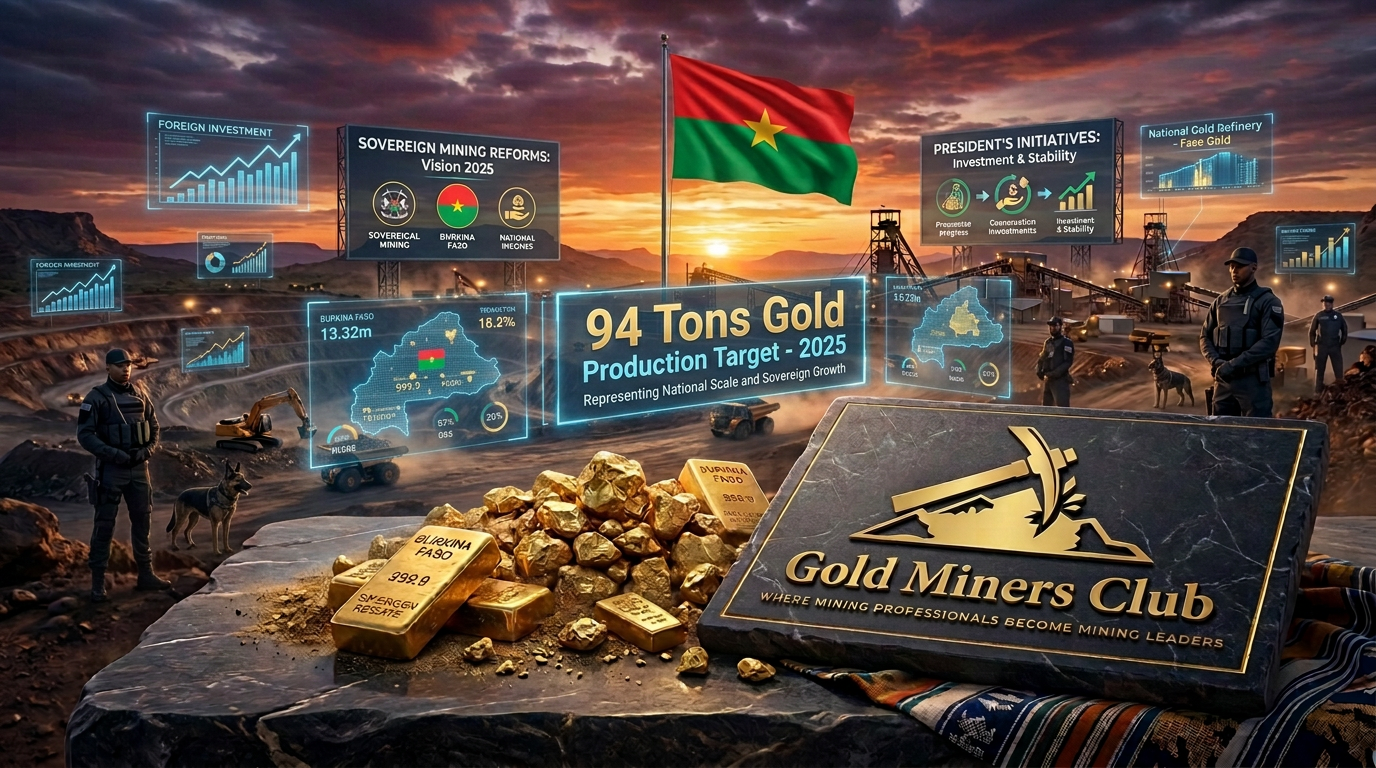
When Burkina Faso’s military-led government set an ambitious gold production target of 94 tonnes for 2025, it signaled a decisive break from past passive resource governance. By 2026, the question is no longer whether the target was met exactly, but whether the reforms launched in 2023–2025 have taken root—and whether the country can sustain momentum amid continuing security challenges, shifting global gold prices, and the difficult task of reassuring foreign investors while asserting sovereign control over mineral wealth.
This update examines the road ahead for Burkina Faso’s gold sector in 2026, covering:
- The current state of production and whether the 94-tonne goal was achieved or revised;
- The latest policy and regulatory developments, including implementation of the 2024 mining code;
- SOPAMIB’s expanding role in audits, cooperative formalization, and gold marketing;
- The security situation and its impact on mining operations;
- Concrete measures the government is taking to build trust with investors; and
- Expert and industry perspectives on what comes next.
Part I: Did Burkina Faso Reach 94 Tons? Production Reality in 2025–2026
1.1 The Official Record
Officials always described the 94-tonne target for 2025 as ambitious. Throughout 2024 and into 2025, the Ministry of Energy, Mines and Quarries released periodic updates that suggested progress yet also acknowledged headwinds. Industrial production from major mines—including Endeavour Mining’s Mana and Houndé operations, IAMGOLD’s Essakane, Nordgold’s Bissa and Bouly, Fortuna Silver’s Séguéla, and Orezone’s Bomboré—remained the backbone of output.
According to government statements reported by Reuters, Bloomberg, and Jeune Afrique in late 2025 and early 2026, Burkina Faso’s total gold production for 2025 was expected to fall somewhat short of 94 tonnes, with estimates clustering in the 80–90 tons range when industrial and formalized artisanal output were combined. Officials attributed the deficit to:
- Security disruptions at several sites and along transport corridors;
- Delays in ramping up certain industrial projects;
- Slower-than-expected formalization of artisanal production; and
- Worldwide market volatility affecting investment decisions.
However, the government emphasized that production had increased from 2023–2024 levels and that the trajectory remained upward. In early 2026, the Ministry signaled that it had retained the 94-tonne goal as a medium-term objective for 2026–2027, rather than abandoning it.
1.2 Artisanal and Cooperative Output
A key uncertainty in the production data is how much artisanal gold official channels actually captured. SOPAMIB noted a considerable increase in gold purchased from registered cooperatives in 2025 compared to previous years, suggesting that formalization was beginning to yield results. However, independent analysts cautioned that a significant part of artisanal gold continued to leak through smuggling networks, particularly in border regions near Togo, Ghana, and Benin.
The IMPACT organization and regional research groups noted in 2025–2026 reports that while official buying counters had expanded, many miners still preferred informal buyers who offered immediate cash, no paperwork, and sometimes better prices. Closing this gap remains central to hitting the 94-tonne target.
1.3 Modified Projections for 2026
For 2026, the government’s working projection—cited in budget documents and mining ministry briefings—is to consolidate production above 90 tonnes, with a stretch goal of reaching or exceeding 94 tonnes if security improves and new industrial projects come online. Primary variables include:
- The ramp-up of new or expanded mines;
- The pace of cooperative registration and official gold sales;
- Gold price trends (high prices incentivize both legal and illegal production);
- Security incidents affecting operations and logistics; and
- Investor response to the revised mining code and audit outcomes.
Part II: Current Policies in 2026 — Implementation and Evolution
2.1 The 2024 Mining Code in Practice
The 2024 amendments to Burkina Faso’s mining code represented the most significant overhaul in over a decade. By 2026, the government was focused on implementation, and multiple important provisions had moved from law to practice:
- Increased State Participation: The state has exercised its options for higher equity stakes in several mining projects, and negotiations over particular terms continued with companies. The government framed this as a matter of “fair partnership,” not expropriation.
- Local Content Requirements: Mining companies must now priorities Burkinabè suppliers and workers. Compliance monitoring has begun, with mixed results. Some companies struggled to find qualified local suppliers, while others invested in training programs to build local capacity.
- Royalty and Tax Adjustments: Higher royalty rates and windfall profit provisions have been applied, generating additional revenue. The government reported increased mining tax receipts in 2025, though exact figures were still being audited in early 2026.
- Local Processing and Refining: The code encourages in-country processing. By 2026, discussions were ongoing about building a domestic gold refinery, though no major project had been finalized. The government argued that local refining would capture more value and reduce reliance on foreign refineries.
2.2 SOPAMIB’s Expanding Mandate
SOPAMIB has evolved from a promotional agency into a central operator in the gold sector. In 2026, its activities include:
- Cooperative Formalization: SOPAMIB reported registering hundreds of cooperatives by early 2026, covering tens of thousands of miners. The agency has established official gold-buying counters in multiple regions and provides training on safe, mercury-free processing.
- Industrial Audits: SOPAMIB’s audit teams, working with the Ministry of Mines and independent auditors, continued to examine industrial mining operations in 2025–2026. The audits focused on production verification, transfer pricing, tax compliance, and environmental obligations. Preliminary findings led to additional tax assessments against several companies, and some disputes were resolved through negotiation.
- Traceability and Certification: SOPAMIB has been developing a gold traceability system to ensure that officially purchased gold is conflict-free and meets international standards, including those of the London Bullion Market Association (LBMA). This is critical to access premium markets and demonstrate responsible sourcing.
- Partnerships: SOPAMIB continued to work with the World Bank, African Development Bank, European Union, and GIZ on capacity building, financing, and technical assistance.
2.3 Anti-Smuggling and Security Policies
The government’s anti-smuggling campaign intensified in 2025–2026:
- Border Controls: Expanded patrols and checkpoints, particularly along the borders with Togo, Ghana, Benin, and Niger.
- Penalties: Harsher fines and prison sentences for illegal gold trading, with multiple high-profile arrests and seizures reported.
- Military Protection: Deployment of security forces to protect mines, convoys, and buying counters.
- Stakeholder Involvement: Efforts to persuade miners to sell through official channels by delivering competitive prices and reducing administrative obstacles.
- Regional Cooperation: Dialogue with neighboring countries on joint actions to combat cross-border smuggling.
Despite these measures, smuggling remains a significant challenge. A 2025 report by the United Nations and independent researchers noted that armed groups continue to profit from artisanal gold in some areas, and that smuggling networks have adapted to increased enforcement.
2.4 Environmental and Social Policies
The government has also tightened environmental and social requirements:
- Mercury Reduction: Promotion of mercury-free processing technologies, in line with the Minamata Convention, which Burkina Faso has ratified.
- Rehabilitation: Requirements for mining companies to fund site rehabilitation and community development.
- Child Labor: Tougher enforcement of laws against child labor in artisanal mining, though implementation remains uneven.
- Community Development Funds: Mining companies must contribute to local development funds, and the government has emphasized that such funds must be managed transparently.
Part III: The Security Situation in 2026 — Progress and Persistent Threats
3.1 The Counterinsurgency Campaign
The security situation remains the single biggest risk factor for Burkina Faso’s mining sector. In 2026, the government’s counterinsurgency campaign—conducted by the armed forces with support from regional and international partners—has made some territorial gains, particularly around major mining sites and urban centers. However, jihadist groups affiliated with Al-Qaeda and the Islamic State continue to operate in rural areas, particularly in the north, east, and parts of the southwest.
Attacks on mining convoys, security forces, and civilians have continued, though their frequency and intensity have fluctuated. The government has claimed progress in reclaiming territory and disrupting militant financing, including through gold. Independent observers are more cautious, noting that the insurgency is far from defeated.
3.2 Impact on Mining Operations
Major industrial mines have largely continued operations, albeit with strengthened security measures. Companies have invested in:
- Convoy escorts and armored vehicles;
- On-site security and perimeter defenses;
- Aerial surveillance and intelligence exchange with security forces;
- Community relations programs to build local support and reduce risks.
Artisanal mining areas remain more vulnerable. In some regions, armed groups have taxed or controlled artisanal sites, and miners have faced threats and extortion. The government’s formalization efforts partly aim to deny militants access to gold revenue, but this requires extending state authority to remote areas—a slow and difficult process.
3.3 The Humanitarian Dimension
The security crisis has displaced hundreds of thousands of people and disrupted livelihoods. Violence, displacement, and the closure of some sites have affected mining communities. The government and humanitarian organizations are struggling to meet needs. For the mining sector, the humanitarian crisis is both a risk (instability, labor disruptions) and a responsibility (companies are expected to contribute to local development and stability).
Part IV: Building Trust with Investors — The Government’s 2026 Strategy
4.1 The Challenge: Balancing Sovereignty and Investment
The government’s mining reforms have been accompanied by nationalist rhetoric and assertive measures—audits, tax assessments, higher state participation, and contract renegotiations. This has created uncertainty among some foreign investors, who worry about retroactive changes, arbitrary treatment, and political risk. At the same time, Burkina Faso needs foreign investment to develop its mining sector, transfer technology, and create jobs.
In 2026, the government is treading a fine line: asserting sovereignty while reassuring investors that Burkina Faso remains open for business. The strategy has several components.
4.2 Concrete Measures to Build Trust
1. Legal Reliability and Predictability
The government has emphasized that the 2024 mining code, while more demanding, provides a stable, predictable legal framework. Officials have said contracts will be honored, disputes will be resolved through recognized mechanisms (including international arbitration), and retroactive changes will be avoided. In 2025–2026, the Ministry of Mines held consultations with industry to clarify implementation and address concerns.
2. Transparent Audits and Negotiations
The audits of industrial mining operations have been a major source of tension. To build trust, the government has taken steps to:
- Publish audit findings (at least in summary form) and explain the basis for tax assessments;
- Engage in dialogue with companies rather than imposing unilateral penalties;
- Offer negotiated settlements where disputes arise; and
- Align audits according to international standards and involve independent experts.
While some companies have complained about the process, others have acknowledged that greater transparency serves everyone’s interests.
3. Investment Facilitation
The government has streamlined permitting procedures, reduced administrative delays, and established one-stop shops for mining investors. The Burkina Faso Investment Promotion Agency (ABI) supports investors and resolves grievances. Mining companies have reported improved communication with the Ministry of Mines, even though challenges remain.
4. Security Guarantees
For investors, security continues a top concern. The government has:
- Deployed military units to protect major mines and transport corridors;
- Shared intelligence with companies on security threats;
- Facilitated coordination between companies and security forces; and
- Invested in sustained stability through community development and counterinsurgency efforts.
These measures haven’t eliminated risk, but they have reduced it enough for many companies to continue operating and even expand.
5. Local Content and Shared Value
The government has promoted local content requirements to ensure mining benefits Burkinabè communities. Companies must hire and train local workers, source locally, and contribute to community development. While some investors initially resisted, many now see these requirements as a way to build social license and reduce conflict risk.
6. International Engagement
Burkina Faso has kept engaging with international partners, including the World Bank, IMF, African Development Bank, and European Union, on mining sector support. The country is still a member of the Extractive Industries Transparency Initiative (EITI), which requires disclosure of mining revenues and contracts. In 2025–2026, the government reaffirmed its EITI pledge and published updated reports.
7. Reassuring Existing Investors
The government has made efforts to retain existing investors by:
- Honoring existing contracts (with adjustments negotiated mutually);
- Providing tax stability for the life of mine in some cases;
- Facilitating gold exports and foreign exchange access; and
- Involving in regular dialogue through the Chamber of Mines and industry associations.
4.3 Investor Outlook in 2026
Investor outlook is mixed but cautiously improving. Some companies have expanded operations or announced new investments, citing Burkina Faso’s geological potential and the government’s capacity to engage. Others have delayed or scaled back plans due to security concerns, regulatory uncertainty, or global market conditions.
Endeavour Mining, one of the largest operators, has maintained its presence and continued investing in its Burkina Faso mines, while publicly acknowledging the challenges. Fortuna Silver has ramped up its Séguéla mine, and Ore zone has continued operations at Bomboré. IAMGOLD and Nordgold have also maintained their operations, though with increased security.
Smaller exploration companies have been more cautious, with some suspending or divesting their Burkina Faso assets. The government knows attracting junior exploration is essential for a long-term pipeline of new mines and is working to address their concerns.
4.4 The Role of Diplomacy
Burkina Faso’s diplomatic realignment—including expulsion of French troops, pivot toward Russia, and engagement with Turkey, China, and other partners—has complicated relations with some traditional investors. However, the government has sought to separate politics from economics, emphasizing that all investors are welcome as long as they respect Burkinabè laws and contribute to development.
In 2026, Burkina Faso continues to participate in regional and international mining forums, including the African Mining Indaba and EITI global conferences, where officials present the country’s reforms and investment opportunities.
Part V: The Road Ahead — Scenarios for 2026 and Beyond
5.1 Optimistic Scenario
- Security improves as counterinsurgency gains are consolidated.
- Formalization accelerates, with more cooperatives registered and more gold sold by official channels.
- Industrial production grows as new projects come online and existing mines expand.
- Investor faith increases as the government demonstrates predictability and equity.
- Burkina Faso reaches or exceeds 94 tonnes in 2026–2027, generating considerable revenue for development.
- Smuggling declines as recognized channels become more attractive and enforcement tightens.
5.2 Business-as-Usual Scenario
- Security is still precarious, with periodic attacks and disruptions.
- Formalization proceeds slowly, with many miners remaining outside the system.
- Industrial production stagnates or grows modestly.
- Investor outlook remains cautious, with some companies staying and others exiting.
- Production hovers around 85–90 tonnes, short of the 94-tonne target.
- Smuggling continues, though at reduced levels.
5.3 Pessimistic Scenario
- Security deteriorates, with major attacks on mining sites or convoys.
- Investors withdraw or suspend operations, citing unacceptable risk.
- Formalization stalls as miners lose faith in the process.
- Production declines below 80 tonnes.
- Smuggling and illicit trade flourish, funding armed groups.
- The resource curse deepens, with corruption and inequality rising.
5.4 Key Indicators to Watch in 2026
- Official gold production figures for 2025 and quarterly 2026 data;
- SOPAMIB’s reported gold purchases from cooperatives;
- Security incidents affecting mining sites and corridors;
- Investment announcements by major and junior companies;
- Tax and royalty receipts from the mining sector;
- EITI reports and transparency indicators;
- Smuggling seizures and arrests;
- Gold price trends and their impact on production and smuggling.
Part VI: Voices and Views from 2026
6.1 Government Officials
In a 2026 interview with Jeune Afrique, a senior official at the Ministry of Energy, Mines and Quarries stated: “We are not against foreign investment. We are against unfair deals. Burkina Faso’s gold must benefit Burkinabè people first, and then our partners. We have revised our laws, we are auditing, we are formalizing. This is not a hostile act—it is a sovereign act. Investors who respect our laws and share value are welcome.”
6.2 Industry Representatives
A spokesperson for the Chamber of Mines of Burkina Faso told Mining Weekly in early 2026: “The government has made progress in clarifying the rules and engaging with industry. But challenges endure—security, taxation, and regulatory uncertainty. We need persistent dialogue and predictability to attract the investment Burkina Faso needs.”
6.3 Civil Society
A representative of REN-LAC (Réseau National de Lutte Anti-Corruption) commented to Le Monde in 2026: “The audits and formalization are positive steps. However, we must ensure revenues are managed transparently and used for public benefit. Otherwise, we risk replacing one form of opacity with another. Civil society must be involved in monitoring.”
6.4 Artisanal Miners
A cooperative leader in the Hauts-Bassins region told AFP in 2026: “We joined the cooperative because we want to sell legally and get a fair price. But we need more support—equipment, financing, training. The government makes a lot, but delivery is slow. We are patient, but we need results.”
Part VII: Conclusion — A Decisive Point
Burkina Faso’s gold sector is at a decisive point in 2026. The reforms launched in 2023–2025—formalization of artisanal mining, SOPAMIB’s audits, the revised mining code, and the anti-smuggling campaign—have established the foundation for a more transparent, equitable, and productive sector. But the gains are fragile, and the challenges remain daunting.
The 94-tonne target remains a powerful symbol of drive. Whether it is achieved in 2026 or later, the deeper goal is to ensure that Burkina Faso’s gold wealth benefits its people, funds development, and bolsters security—rather than enriching elites, fueling conflict, or flowing illicitly across borders.
Building investor faith is essential to this vision. The government’s 2026 strategy—combining legal stability, transparent audits, investment facilitation, security guarantees, local content, and international engagement—reflects an awareness that Burkina Faso cannot develop its mining sector alone. It needs partners who bring capital, technology, and expertise. But those partners must respect Burkinabè sovereignty and contribute to shared prosperity.
The road ahead appears uncertain. Security remains the greatest risk. Governance and transparency are the greatest opportunities. And the endurance of the Burkinabè people—miners, communities, officials, and civil society—is the greatest asset.
If Burkina Faso can navigate this juncture successfully, it could become a model for accountable resource governance in the Sahel and beyond. If it falters, the consequences will be experienced for generations. The world will be watching—and the people of Burkina Faso will be the first to know whether their gold truly belongs to them.
References and News Sources:
The following sources provide reporting and analysis on Burkina Faso’s gold sector in 2025–2026:
- Reuters — “Burkina Faso gold output rises but falls short of target” (2025); “Burkina Faso seeks to reassure investors amid mining reforms” (2026).
- Bloomberg — “Burkina Faso audits gold mines as junta seeks bigger share” (2025); “Burkina Faso’s gold sector faces security test” (2026).
- Agence France-Presse (AFP) — “Burkina Faso junta tightens grip on gold” (2025); “Artisanal miners in Burkina Faso seek fair deal” (2026).
- Jeune Afrique — “Burkina Faso: la ruée vers l’or et les réformes” (2025); “SOPAMIB, le bras armé de l’État dans l’orpaillage” (2026).
- Mining Weekly — “Burkina Faso mining code implementation progresses” (2025); “Chamber of Mines calls for dialogue” (2026).
- The Africa Report — “Burkina Faso’s gold: sovereignty vs investment” (2025).
- IMF Country Reports — Burkina Faso: Selected Issues (2025–2026).
- World Bank — “Burkina Faso Mining Sector Support Project” progress reports (2025–2026).
- Extractive Industries Transparency Initiative (EITI) — Burkina Faso country reports (2025–2026).
- IMPACT — “Artisanal mining and conflict in the Sahel: 2026 update.”
- United Nations — Reports of the Secretary-General on the Sahel (2025–2026).
- Human Rights Watch — “Child labor in artisanal gold mining: Burkina Faso update” (2025).
- REN-LAC and CIP — Civil society reports on mining revenue transparency (2025–2026).
- Endeavour Mining, IAMGOLD, Nordgold, Fortuna Silver, Orezone — Corporate annual reports and press releases (2025–2026).
- BBC Africa — “Burkina Faso’s gold: who benefits?” (2025).
- Le Monde — “Au Burkina Faso, l’or et le pouvoir” (2025–2026).
- Financial Times — “Burkina Faso mining: risk and reward” (2025).
- Mining Indaba — Conference presentations and panel discussions (2026).
- SOPAMIB — Annual reports and public statements (2025–2026).
- Ministry of Energy, Mines and Quarries, Burkina Faso — Official statements, budget documents, and press releases (2025–2026).
Note: This article synthesizes publicly available information from news reports, government statements, corporate disclosures, and civil society reports as of early 2026. Specific figures, such as production numbers and tax receipts, are based on official announcements and media reporting and should be verified against primary sources. The security situation in Burkina Faso is fluid, and readers should consult the latest reporting for updates. Some sources are cited generically to reflect the broad range of reporting available; exact article titles and dates may vary.