

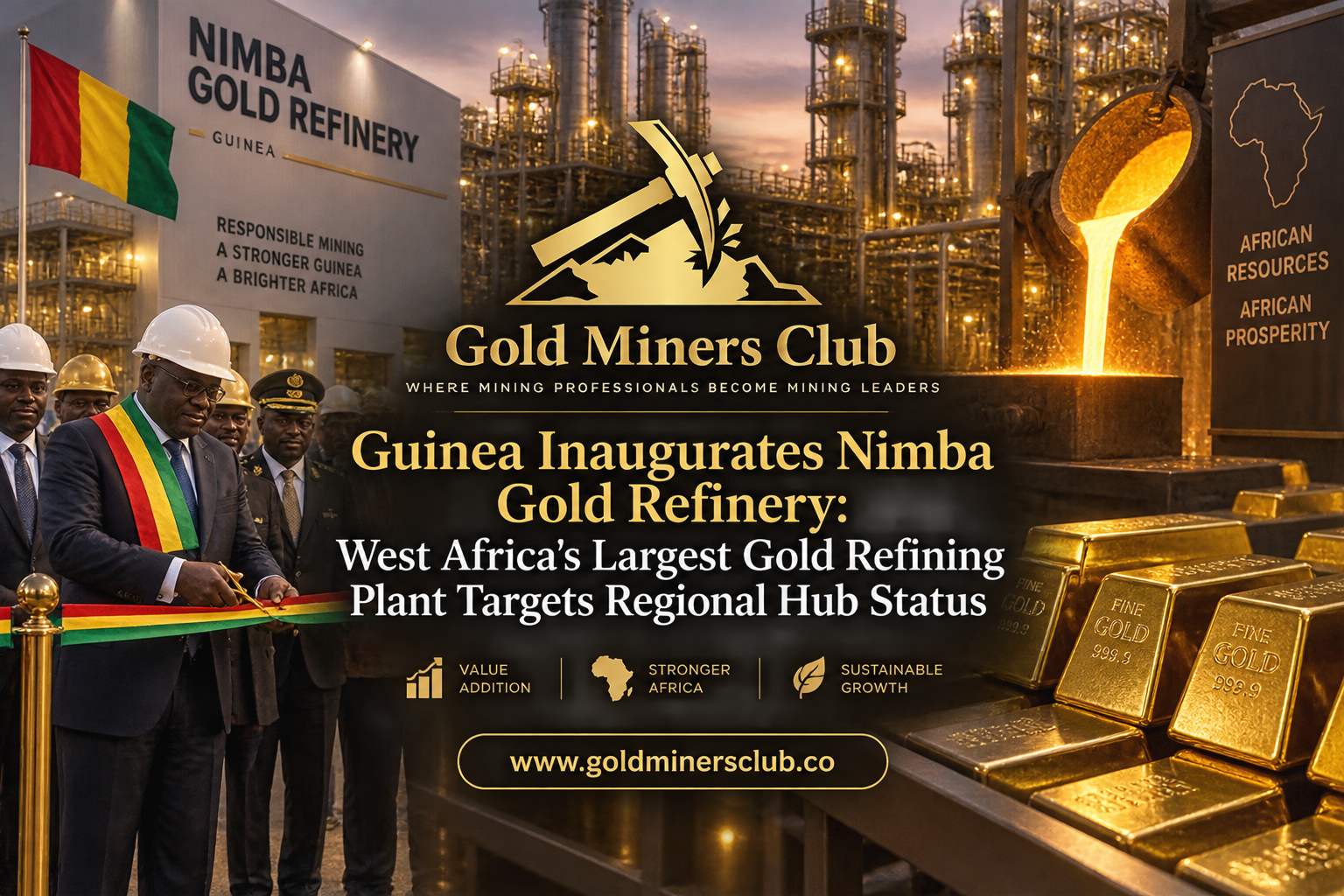
By: GOLD MINERS CLUB Conakry, 2 November 2026
Guinea has formally entered the gold refining business. On Sunday, 1 November 2026, President Mamadi Doumbouya inaugurated the Nimba Gold Refinery (NGR) in the Gbessia district of Conakry, in front of senior state officials, diplomats and players from the gold sector. Presented as the largest refining facility on the African continent, the plant marks a shift from exporting raw gold to processing it at home.
A turning point after decades of raw exports
For close to seven decades, most of the value created by refining Guinean gold left the country. Mines Minister Bouna Sylla told the ceremony that this era is over, saying the refinery will now bring jobs, skills, revenue and development opportunities to the national economy.
The inauguration follows a rapid sequence of policy moves. In late June 2026, President Doumbouya banned raw gold exports with immediate effect, copying the approach already applied to the bauxite industry. On 3 July, decrees read on national television opened a 30-day negotiation period with mining companies to define how the suspension of raw gold exports will work, with operators required to submit compliance plans to the Ministry of Mines. The stated aim is to make refineries located in Guinea the primary buyers of domestically produced raw gold.
Production capacity
The numbers attached to the project are large:
- Nominal capacity: 733 tonnes of gold per year, according to company representative Moussa Magassouba at the inauguration.
- Initial capacity: about 530 tonnes per year at the start of commercial operations, as reported by Ecofin Agency in July.
- Investment: about US$30 million, according to Bangaly Steve Toure, deputy chief executive of the Guinea Mining Investment Fund, speaking to Reuters. The refinery is structured as a public-private partnership.
- Financial flow: management says that even at 50% of capacity the plant could generate an estimated US$4.5 billion per year in financial flows.
- Location: Gbessia, close to Conakry International Airport, which eases logistics for inbound doré and outbound refined bullion.
These capacity figures are far above what Guinea produces today. The country reported gold exports of 2.33 million ounces in 2025, of which 1.59 million ounces came from artisanal mining. West Africa as a whole produced roughly 11 million ounces in 2025, and Guinea’s output of about 2.32 million ounces was worth around US$7 billion, yet less than 1% of that value was retained locally. Because the plant is sized well beyond national output, its business case depends on attracting gold from neighbouring countries.
Economic and fiscal benefits for Guinea
Value retention. Refining, assaying and trading margins that used to be captured abroad can now be earned in Guinea, mirroring the strategy of the country’s bauxite sector, where three alumina refineries are currently under construction.
Foreign-exchange reserves. Under the Mining Code, the state will buy up to 30% of the production of semi-industrial and industrial gold companies in Guinean francs. Officials say this will strengthen the foreign-currency reserves of the Central Bank of the Republic of Guinea and support macroeconomic stability.
Jobs and skills. The company points to durable qualified employment and a large transfer of technical know-how to Guinean youth, from metallurgy and laboratory work to security, compliance and logistics.
Traceability and formalisation. Artisanal miners account for roughly 70% of national gold production, and informality and smuggling have long plagued the sector. Authorities plan to formalise artisanal mining and strengthen traceability, so that more gold flows through licensed channels into a refinery that can certify its origin.
Regional benefits: the case for a West African hub
Sylla has said Guinea wants to become a gold refining centre for the sub-region, describing the plant as capable of handling output from across West Africa. He compared the ambition to the United Arab Emirates, which built a major refining industry without mining of its own, and argued that a refinery succeeds or fails on economics, not politics.
For the region, a credible local refiner could offer:
- Shorter, cheaper supply chains for producers in Mali, Sierra Leone, Côte d’Ivoire and elsewhere that currently ship bullion to the Middle East or Europe for refining.
- Better transparency through a documented chain of custody, which matters to international buyers and responsible-sourcing standards.
- Industrial spillovers such as assay laboratories, secure transport, financial services and skilled technical jobs clustered around Conakry.
Challenges ahead
The project’s success is not guaranteed. Analysts note that the first hurdle is securing a meaningful share of locally produced gold, particularly artisanal output whose true scale is uncertain. The regional race is also intensifying: Burkina Faso has announced plans for its first refinery, and Ghana is in a development phase of its own. Industrial producers such as AngloGold Ashanti and Predictive Discovery will watch closely how the new rules, pricing and compliance requirements work in practice. Guinea will also have to prove the plant can meet the quality standards that international bullion markets demand.
Outlook
The inauguration of the Nimba Gold Refinery is the most visible step yet in Guinea’s push to industrialise its mineral wealth, tied by officials to the national Simandou 2040 vision. If artisanal gold can be brought into formal channels and neighbouring producers are convinced to route bullion through Conakry, NGR could anchor a regional hub. If not, it risks running below capacity. The next twelve months of throughput data will show which path Guinea is on.
News references
- Guinee360, “Guinée : Inauguration historique de la Nimba Gold Refinery, le nouveau géant du raffinage d’or africain”, 1 November 2026. https://www.guinee360.com/01/11/2026/guinee-inauguration-historique-de-la-nimba-gold-refinery-le-nouveau-geant-du-raffinage-dor-africain/
- Guineematin.com, “Guinée : Mamadi Doumbouya inaugure Nimba Gold Refinery, première raffinerie d’or du pays”, 1 November 2026. https://guineematin.com/2026/11/01/guinee-mamadi-doumbouya-inaugure-nimba-gold-refinery-premiere-raffinerie-dor-du-pays/
- Reuters via Kitco, “Guinea plans regional gold refining hub as West African race intensifies”, 29 June 2026. https://www.kitco.com/news/off-the-wire/2026-06-29/guinea-plans-regional-gold-refining-hub-west-african-race-intensifies
- Miningmx, “Guinea eyes regional gold refining hub”, June 2026. https://www.miningmx.com/?p=65791
- Ecofin Agency, “Artisanal Mining Reform: Guinea’s Next Step Toward Gold Refining”, 30 June 2026. https://www.ecofinagency.com/news-industry/3006-56911-artisanal-mining-reform-guinea-s-next-step-toward-gold-refining
- Ecofin Agency, “Guinea Opens Talks With Miners to Advance Domestic Gold Refining”, 6 July 2026. https://www.ecofinagency.com/news-industry/0607-57082-guinea-opens-talks-with-miners-to-advance-domestic-gold-refining
- Financial Afrik, “Guinée : le président Mamadi Doumbouya annonce le lancement de la Nimba Gold Refinery”, 23 June 2026. https://www.financialafrik.com/2026/06/23/guinee-le-president-mamadi-doumbouya-annonce-le-lancement-de-la-nimba-gold-refinery/
- CNBC Africa, “Guinea plans regional gold refining hub as West African race intensifies”, 29 June 2026. https://www.cnbcafrica.com/2026/guinea-plans-regional-gold-refining-hub-as-west-african-race-intensifies
Note: capacity and financial-flow figures come from the company and press reports; the 530 t initial and 733 t nominal capacity figures should be confirmed against official NGR documentation before publication.