
By Gold Miners Club | www.goldminersclub.co | Updated 28 October 2026
Introduction: Beijing Is Now Controlling the Whole Value Chain
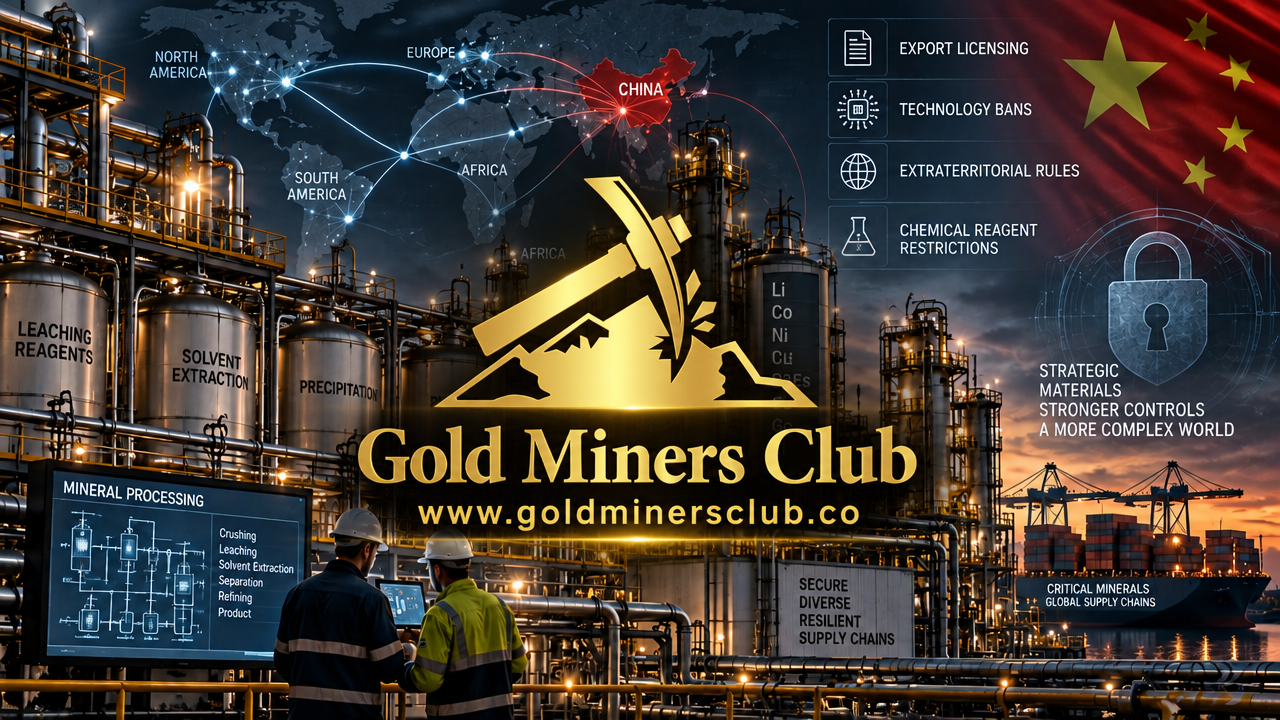
For years, the critical minerals debate focused on mined ore. In 2026, the conversation has moved downstream. China has layered export licensing, technology bans, extraterritorial rules and, most recently, restrictions on the chemical reagents that mineral processing depends on. For anyone designing, financing or operating a mineral processing plant or refinery, this changes feedstock, flowsheet and procurement decisions.
This article explains what China has restricted, how the regime has evolved through 2026, and what the real-world consequences are for miners, refiners and EPC project teams.
Key Takeaways
- China’s controls now cover minerals and metals, processing technology, equipment and chemical inputs, not just raw materials.
- The International Energy Agency (IEA) reports that the number of mineral tariff codes under Chinese export controls has tripled since 2023.
- China’s halt to sulphuric acid exports from May 2026 hits leaching and refining of copper, cobalt, nickel, uranium and rare earths.
- A major suspension of China’s October 2025 package is due to lapse on 10 November 2026, so plant owners should plan for several outcomes.
- Supply security is now an engineering and procurement design criterion, not only a commercial one.
A Timeline of China’s Restrictions (2023–2026)
2023–2024: Metals, graphite and the technology ban
China began with gallium and germanium controls in 2023, then added natural flake graphite in late 2023. On 21 December 2023, it banned the export of technology for rare earth extraction, separation and smelting, the core know-how that turns ore into usable oxides and metals. In 2024, antimony and super-hard material equipment followed, effective 15 September 2024.
April 2025: Licensing for seven rare earths
China introduced case-by-case export licenses for seven medium and heavy rare earths: samarium, gadolinium, terbium, dysprosium, lutetium, scandium and yttrium, including related oxides, alloys, compounds and magnet materials. This layer remains in force.
October 2025: The sweeping package, then a pause
The 9 October 2025 measures went much further. They added five more rare earths, controls on related equipment and technology, controls on battery chokepoints (cathode materials, precursors, graphite anode materials and battery manufacturing equipment) and an extraterritorial “0.1% rule”, under which products made abroad containing even small Chinese-origin rare earth content could need Beijing’s approval. After the Busan summit, China suspended this package until 10 November 2026.
January 2026: Licensing catalogue expansion
From 1 January 2026, the export licensing catalogue added rare earth compounds (samarium, gadolinium, lutetium) and silver, alongside tightened rules on tungsten and antimony. China published a list of 44 approved silver exporters for 2026–2027. Separate restrictions announced in January 2026 targeted Japan, covering dual-use products containing critical minerals.
April–May 2026: Sulphuric acid
On 10 April 2026, China indicated it would halt exports of sulphuric acid from May. The ban reportedly covers acid produced as a by-product of copper and zinc smelting, replacing a prior quota of roughly 700,000 tonnes a year with a complete stop. Only high-purity electronic-grade acid remained eligible, subject to special approval. IEA analysis ties the move to disrupted Sulphur supply and describes it as rippling across mineral and fertiliser value chains. Reports have also suggested Beijing has signaled it may reconsider, so buyers should verify the current status with suppliers.
June–July 2026: Enforcement and entity listings
On 22 June 2026 China placed ten US firms on its export control list, including MP Materials and USA Rare Earth, with third-party effects on sales of China-origin dual-use items. Chinese authorities have also stepped up enforcement, penalizing at least 11 companies for illegal exports of restricted rare earths and critical minerals.
Why Chemical Inputs Matter as Much as Minerals
Sulphuric acid is the quiet backbone of hydrometallurgy. It is used in heap and tank leaching of copper, nickel and cobalt laterites, uranium leaching, rare earth cracking and purified phosphoric acid production. Analysts estimate that more than half of projected 2026 global lithium, cobalt, rare earth and purified phosphoric acid output is exposed to Sulphur and sulphuric acid market shocks, and that roughly four-fifths of 2026 cobalt supply is tied to acid-based refining.
China accounts for more than 40% of global sulphuric acid production and was the world’s largest exporter. Exports had surged 73% in 2025 to 4.65 million tonnes before the reversal. Chile, which imports over one million tonnes of Chinese acid a year, has about a fifth of its copper output reliant on acid-dependent processing, and Chilean acid prices rose sharply after the announcement.
The Impacts
1. Price spikes and a two-tier market
The IEA reports that prices for affected minerals more than doubled in some cases, with tungsten rising about sixfold, and that export controls opened a sharp price gap between Chinese domestic markets and the rest of the world.
2. Reagent and feedstock risk for operating plants
Operations in Chile, the DRC, Zambia and Namibia that rely on imported acid face higher operating costs and potential curtailments. Plants without captive acid production, or without a secure Sulphur supply, carry the most exposure.
3. Technology and equipment bottlenecks
With rare earth extraction and separation know-how restricted since 2023, and equipment and technology controls only paused, non-Chinese refiners cannot assume access to proven Chinese process expertise. This raises the value of independently licensed or locally developed flowsheets.
4. Downstream industrial exposure
The IEA estimates that full enforcement of China’s rare earth controls would put around US$6.5 trillion a year of downstream production outside China at risk, plus roughly US$300 billion tied to battery-grade graphite. China’s share of rare earth refining fell from over 90% in 2023 to about 85% in 2025, which shows diversification is starting but remains slow.
5. Policy responses abroad
The United States has advanced legislation on mine permitting and a strategic reserve, and a 30 July 2026 presidential determination under the Defense Production Act targets exports of recoverable critical minerals such as black mass, end-of-life magnets and scrap. Japan is exploring seabed rare earths. Europe is building stockpiles. All of this increases demand for new refining and processing capacity outside China.
What Plant Owners and Project Developers Should Do
- Map your reagent exposure. Identify acid, sulphur, lime, solvents and extractants by origin, and test alternatives.
- Consider captive acid capacity. Sulphur-burning acid plants or smelter acid integration reduce dependence on traded acid.
- Design for flexibility. Specify flowsheets and materials of construction that tolerate alternative reagent grades and feed variability.
- Diversify equipment and technology sourcing. Qualify non-Chinese vendors and process licensors early in front-end engineering.
- Build scenario plans around 10 November 2026. Model extension, selective reactivation and full restoration of the suspended controls.
- Integrate supply security into EPC scoping. Procurement strategy, long-lead items and logistics belong in the feasibility stage, not after contract award.
How an EPC Partner Helps
An experienced EPC contractor for mineral processing plants and refineries can stress-test flowsheets against reagent shocks, size captive utilities, qualify alternative suppliers and phase construction around policy risk. If you are planning a new processing facility or de-risking an existing one, speak with the Gold Miners Club team at www.goldminersclub.co.
Frequently Asked Questions
Has China banned exports of critical minerals outright? No single blanket ban exists. China uses licensing, entity listings, technology bans and, in the case of sulphuric acid, a de facto export halt. Controls differ by material.
Which rare earths currently need an export license? Samarium, gadolinium, terbium, dysprosium, lutetium, scandium and yttrium, under the April 2025 controls, with additional compounds added in the 2026 catalogue.
What happens on 10 November 2026? China’s suspension of its October 2025 package (including the 0.1% rule, five more rare earths and battery material controls) is scheduled to expire. As of late October, analysts report no formal extension, though a US–China trade arrangement has been extended to 10 January 2027. Check official Ministry of Commerce announcements for updates.
Why does sulphuric acid matter for critical minerals? It is the main leaching reagent for copper, cobalt, nickel, uranium and rare earths, so restrictions raise costs and can curtail output.
How can refineries reduce exposure? Diversify suppliers, add captive reagent capacity, qualify alternative technology and plan procurement around policy dates.
Disclaimer: This article is general information, not legal, trade-compliance or investment advice. Export control rules change frequently; verify with official sources and qualified advisers.
News References (2026)
- International Energy Agency, Global Critical Minerals Outlook 2026, executive summary: tripling of controlled tariff codes, price divergence, battery chokepoints and the sulphuric acid curb. https://www.iea.org/reports/global-critical-minerals-outlook-2026/executive-summary
- Bloomberg, “China to Ban Sulfuric Acid Exports as War Hits Supply,” 10 April 2026. https://www.bloomberg.com/news/articles/2026-04-10/china-moves-to-ban-sulfuric-acid-exports-as-iran-war-hits-supply
- Exiger, “China Halts Sulphuric Acid Exports as War Squeezes Global Supply,” 16 April 2026. https://www.exiger.com/perspectives/china-halts-sulphuric-acid-exports-as-war-squeezes-global-supply/
- Silmaril Media, “Two Shocks, One Chemical: How the Hormuz Closure and China’s Export Ban Are Strangling Critical Mineral Processing,” 2026. https://silmarilmedia.com/article/hormuz-china-sulphuric-acid-crisis-critical-minerals-processing-2026
- Caixin Global, “China Steps Up Enforcement of Critical Mineral Export Controls,” 29 May 2026. https://www.caixinglobal.com/2026-05-29/china-steps-up-enforcement-of-critical-mineral-export-controls-102449252.html
- The Conference Board, “Critical Minerals: Impact of Export Regulations,” 9 July 2026. https://www.conference-board.org/research/policy-backgrounders/critical-minerals-impact-of-export-regulations
- Sasakawa Peace Foundation, “China’s Weaponization of Critical Minerals and Its Underlying Drivers” (Japan-targeted controls, 2026). https://www.spf.org/en/units_japan-us-and-security-studies/eisei-detail016.html
- Andersen Institute, “China’s Export Controls: Critical Minerals and Strategic Pressure Points,” 2026. https://anderseninstitute.org/chinas-export-control-architecture-and-its-use-of-critical-minerals-as-strategic-pressure-points/
- TechTimes, “Congress Moves to Break China Rare Earth Grip Before November Deadline,” 6 October 2026. https://www.techtimes.com/articles/328654/20261006/congress-moves-break-china-rare-earth-grip-before-november-deadline.htm
- Startup Fortune, “China’s Rare Earth Truce Runs Out on November 10 With No Renewal in Sight,” October 2026. https://startupfortune.com/chinas-rare-earth-truce-runs-out-on-november-10-with-no-renewal-in-sight/
- Electronics Risk Brief, “5 days to 10 November: the rare-earth date buyers still can’t plan around,” 26 October 2026. https://electronicsriskbrief.substack.com/p/5-days-to-10-november-the-rare-earth
- Modern Diplomacy, “The Shenzhen Auction,” 26 October 2026. https://moderndiplomacy.eu/2026/10/26/trump-xi-putin-shenzhen-apec-trilateral-summit-cost-allies
- AI Horizon Network, “China rare earth export controls: timeline 2025 to 2027,” October 2026. https://www.aihorizonnetwork.com/blog/china-rare-earth-export-controls-timeline
- Council on Foreign Relations, “Dismantling China’s Supply-Chain Weapon,” 2026. https://www.cfr.org/reports/dismantling-chinas-supply-chain-weapon
- CNBC, “China to restrict silver exports, echoing rare earths playbook,” 31 December 2025 (background for the 1 January 2026 catalogue). https://www.cnbc.com/2025/12/31/china-silver-export-controls-2026-us-economy-prices-rare-earths-critical-minerals-xag-metals.html